
One Big Beautiful Bill Act: How Trump’s 2025 Megabill Reshaped U.S. Taxes, Welfare, Energy, and Defense
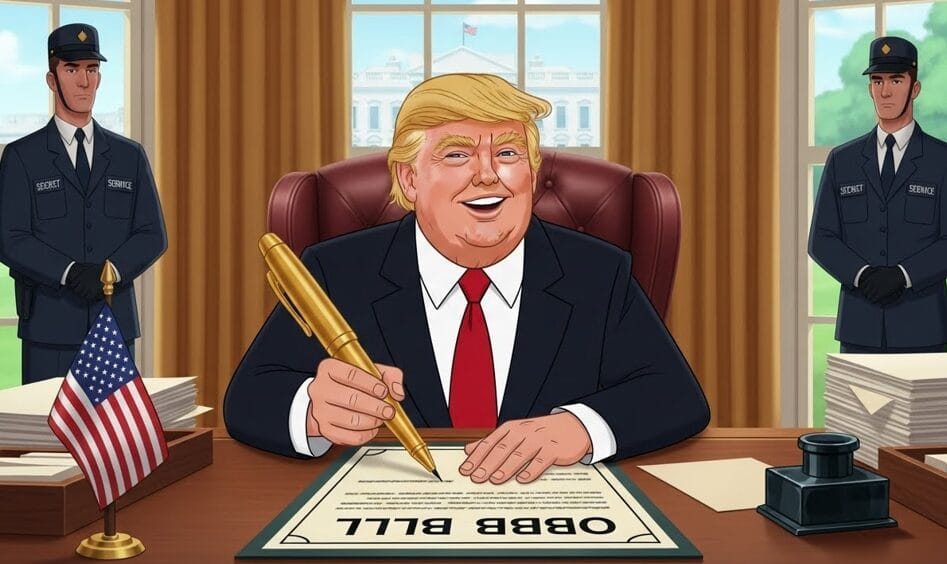
The One Big Beautiful Bill Act, often called the OBBBA, is a sweeping U.S. budget and tax package signed by President Donald Trump on July 4, 2025. Formally enacted as Public Law 119-21, the law combines tax cuts, defense and border spending, Medicaid and SNAP changes, student loan reforms, and a rollback of several clean energy incentives. It is not simply a tax bill. It is a broad restructuring of U.S. fiscal, social, industrial, and energy policy. Source: IRS, One Big Beautiful Bill provisions; CBO, Estimated Budgetary Effects of Public Law 119-21
Key Takeaways
- The OBBBA was enacted on July 4, 2025, as Public Law 119-21.
- It extends and locks in much of the individual tax structure created by the 2017 Tax Cuts and Jobs Act.
- “No tax on tips” and “no tax on overtime” are not full tax exemptions. They are limited federal income tax deductions.
- The Congressional Budget Office estimates that the law will increase federal deficits by about $3.4 trillion from 2025 to 2034.
- Related estimates suggest that the number of uninsured Americans will rise by about 10 million by 2034.
- The law reduces or accelerates the phaseout of several Inflation Reduction Act clean energy incentives.
1. What Is the One Big Beautiful Bill Act?
The One Big Beautiful Bill Act is a large reconciliation law that combines tax policy, spending cuts, defense funding, border enforcement, welfare eligibility changes, student loan limits, and energy policy revisions. Supporters describe it as a pro-growth, pro-worker, pro-security package. Critics argue that it expands deficits, weakens the social safety net, and slows the clean energy transition. Source: CBO, Estimated Budgetary Effects of Public Law 119-21
2. Tax Policy: TCJA Extension and New Deductions
A central feature of the OBBBA is the continuation of the individual income tax structure created by the 2017 Tax Cuts and Jobs Act. The law also introduces targeted deductions for tips, overtime pay, auto loan interest, and older Americans. Many of these new deductions apply from 2025 through 2028, meaning they are temporary rather than permanent benefits. Source: IRS, Tax deductions for working Americans and seniors
| Provision | Main Feature | Accurate Interpretation |
|---|---|---|
| TCJA individual rates | Extends the 2017 individual tax structure | Locks in a lower-rate individual income tax framework |
| Tips | Up to $25,000 deduction | Limited deduction, not full tax exemption |
| Overtime pay | Up to $12,500 deduction, or $25,000 for joint filers | Federal income tax deduction; payroll taxes may still apply |
| Auto loan interest | Up to $10,000 deduction | Subject to vehicle and income requirements |
| Older Americans | $6,000 additional deduction for people 65 and older | Temporary 2025–2028 benefit, phased out at higher incomes |
According to the IRS, people age 65 and older may claim an additional $6,000 deduction from 2025 through 2028. If both spouses qualify, a married couple filing jointly may claim up to $12,000. The deduction begins to phase out when modified adjusted gross income exceeds $75,000 for single filers or $150,000 for joint filers. Source: IRS, OBBBA provisions for individuals and workers
The overtime deduction allows eligible taxpayers to deduct up to $12,500, or $25,000 for joint filers. However, the deduction generally applies to the overtime premium portion rather than every dollar of overtime-related pay. It is also separate from payroll tax treatment. Source: IRS, No tax on tips and overtime guidance
3. Defense and Border Security: A Major Spending Expansion
The OBBBA includes a large increase in defense and border-related spending. Defense-related funds are directed toward areas such as missile defense, nuclear modernization, shipbuilding, industrial base expansion, and military readiness. Public reporting and policy summaries commonly describe the defense increase as roughly $150 billion in additional funding.
The law also expands immigration enforcement and border security funding. ICE-related resources increase substantially over several years, strengthening detention, deportation, and enforcement capacity. A cautious formulation is that ICE becomes one of the most heavily funded federal law enforcement agencies, rather than calling it the single largest enforcement agency without qualification.
4. Medicaid and SNAP: A Shift Toward Stricter Eligibility
The OBBBA reduces Medicaid spending and introduces or expands work requirements for certain adult beneficiaries. Instead of using a single percentage such as “a 12% Medicaid cut,” it is more accurate to describe the final law as combining large Medicaid spending reductions with stricter eligibility and reporting rules. Source: AMA, Medicaid and ACA provisions in OBBBA
Related CBO-based estimates indicate that the law will increase the number of uninsured Americans by about 10 million by 2034. This projected increase reflects Medicaid changes, Affordable Care Act marketplace effects, and administrative barriers that may reduce coverage. Source: American Hospital Association, CBO projection on uninsured and deficit
SNAP, commonly known as food stamps, also changes under the law. A simplified statement that the federal administrative cost share falls from 50% to 25% can be misleading without context. A more accurate summary is that the law shifts more SNAP-related costs and operational burdens toward state governments.
5. Student Loans: New Limits and Reduced Benefits
The law also revises federal student loan policy. It places new limits on borrowing, especially for graduate and professional students, and reduces some subsidized or interest-related benefits. Supporters argue that these changes help contain excessive education debt. Critics warn that they could make graduate and professional education less accessible for lower-income and middle-class students.
6. Energy Policy: Rolling Back IRA Clean Energy Incentives
On energy policy, the OBBBA marks a clear shift away from the Biden-era Inflation Reduction Act framework. Several clean energy credits for sectors such as wind, solar, electric vehicles, batteries, and related supply chains are reduced, accelerated toward expiration, or made harder to claim. This could slow the pace of U.S. clean energy deployment.
At the same time, the law creates a more favorable policy environment for fossil fuel production and traditional energy industries. In the short run, supporters argue that this could support domestic energy production and price stability. In the long run, critics argue that it may weaken U.S. clean energy competitiveness and delay emissions reductions.
7. Fiscal Impact: CBO Estimates a $3.4 Trillion Deficit Increase
The Congressional Budget Office estimates that Public Law 119-21 will increase federal deficits by about $3.4 trillion over the 2025–2034 period. The basic structure is that direct spending falls by about $1.1 trillion, but revenues fall by about $4.5 trillion, producing a large net deficit increase. Source: CBO, Estimated Budgetary Effects of Public Law 119-21
Some fiscal watchdog analyses describe the total cost as roughly $4.1 trillion when additional interest costs are included. Therefore, the CBO’s $3.4 trillion figure and the $4.1 trillion interest-inclusive estimate should not be treated as identical numbers.
8. Pros and Cons of the OBBBA
| Area | Potential Benefits | Potential Costs |
|---|---|---|
| Economy | Lower tax burden for some workers and seniors; stronger investment incentives | Lower revenue and higher long-term deficits |
| Social safety net | More eligibility verification and lower federal spending | Higher uninsured rate and greater burden on low-income households |
| Defense and border | Stronger military capacity and border enforcement | Higher enforcement costs and civil-liberties concerns |
| Energy | Support for traditional energy production and possible short-term price stability | Weaker clean energy incentives and slower climate progress |
| Education | Greater control over federal loan exposure | Reduced access to graduate and professional education |
9. Policy Interpretation
1. A Stronger Supply-Side Economic Model
The OBBBA reinforces a supply-side policy framework. Its basic assumption is that lower taxes, stronger investment incentives, and regulatory relief can stimulate production, investment, and growth.
2. A Shift from Expanded Welfare to Conditional Welfare
Medicaid work requirements and SNAP cost shifts represent a move from broad federal safety-net expansion toward stricter eligibility and greater state responsibility. Supporters view this as fiscal discipline and anti-abuse reform. Critics see it as a reduction in health care and food security for vulnerable households.
3. A Return Toward Traditional Energy
The rollback of IRA incentives signals a major energy-policy pivot. The United States moves away from aggressive clean energy subsidy expansion and toward a more fossil-fuel-friendly framework.
10. FAQ
Q1. When was the One Big Beautiful Bill Act enacted?
It was signed into law on July 4, 2025, as Public Law 119-21.
Q2. Are tips and overtime fully tax-free?
No. The law provides limited federal income tax deductions for eligible tips and overtime pay. Payroll taxes such as Social Security and Medicare taxes may still apply.
Q3. How much does the OBBBA increase the federal deficit?
The CBO estimates that it will increase federal deficits by about $3.4 trillion from 2025 to 2034. Some interest-inclusive analyses put the cost closer to $4.1 trillion.
Q4. What happens to Medicaid?
The law reduces Medicaid spending and adds or expands work requirements for certain adult beneficiaries. Related estimates suggest that the number of uninsured Americans will rise by about 10 million by 2034.
Q5. How does the law affect clean energy?
It reduces or accelerates the phaseout of several Inflation Reduction Act clean energy incentives, while creating a more favorable environment for traditional energy production.
Conclusion: A Structural Turn in U.S. Policy
The One Big Beautiful Bill Act is not just another tax bill. It is a structural policy shift that combines tax cuts, stronger defense and border enforcement, stricter welfare rules, student loan limits, and a retreat from parts of the clean energy agenda.
Supporters argue that the law rewards work, strengthens security, encourages investment, and restores a more traditional energy policy. Critics argue that it increases deficits, raises the uninsured rate, weakens support for low-income households, and slows the clean energy transition.
In one sentence, the OBBBA can be understood as a law that prioritizes growth, security, and traditional energy while accepting larger deficits and a weaker federal safety net as the tradeoff.