Strategic Report: The Rise of Direct-to-Cell Technology and the Global Race for Telecommunications Supremacy
Introduction
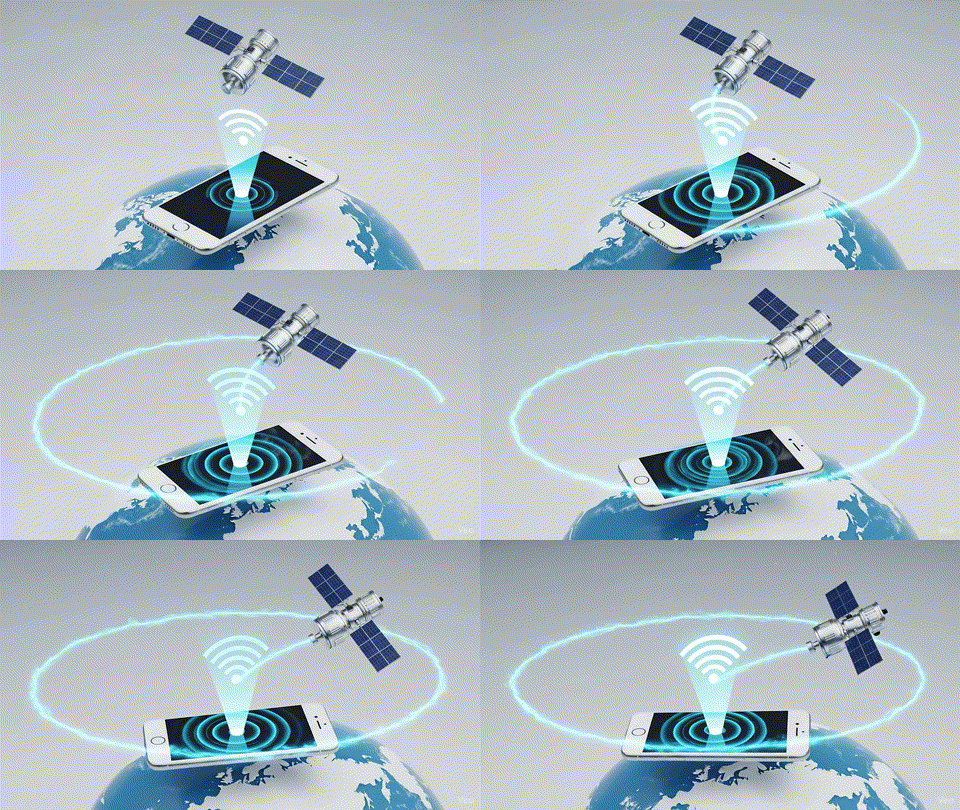
In 2025, the global telecommunications industry is facing a massive paradigm shift that overcomes the physical limitations of terrestrial networks by utilizing space as a new pathway for data transmission. This technology, termed ‘Cell-to-Phone’ or ‘Direct-to-Cell,’ enables direct communication between Low Earth Orbit (LEO) satellites and standard consumer smartphones without the need for expensive specialized equipment or dedicated terminals.
This development is a result of technological advancements converging with the reality that approximately 30% of the global population still lacks internet access (based on offline population estimates) or lives in cellular dead zones. Furthermore, there is a growing demand to secure network resilience in the face of frequent natural disasters caused by climate change. This report provides an in-depth analysis of the concept of Cell-to-Phone technology, its key challenges, technical approaches to resolve them, and the growing market outlook. Furthermore, by comparing the technology policies and corporate strategies of major nations such as the US, Europe, Japan, and South Korea, we aim to forecast the direction of space communications supremacy that will define the upcoming 6G era.
1. Concept and Technical Architecture of Cell-to-Phone
1.1 Definition and Paradigm Shift
Cell-to-Phone technology refers to a system where satellites in Low Earth Orbit (LEO, altitude 300–2,000 km) function like terrestrial cell towers, communicating directly with unmodified smartphones or smartphones equipped with standard NTN (Non-Terrestrial Network) chipsets. Unlike past Mobile Satellite Services (MSS) such as Iridium or Globalstar, which required dedicated terminals with bulky antennas, Cell-to-Phone is innovative in that it utilizes the LTE/5G smartphones already in consumers’ pockets.
The emergence of this technology fundamentally changes the concept of coverage. Traditional terrestrial carriers have pursued a ‘Population Coverage’ strategy, installing base stations centered around densely populated areas, leaving significant portions of the Earth’s surface as communication dead zones. Cell-to-Phone eliminates these geographical constraints to achieve ‘Geographical Coverage,’ realizing ‘Ubiquitous Connectivity’ that guarantees connection wherever the user may be. This goes beyond mere convenience; it serves as essential infrastructure ensuring survival in disaster situations.
1.2 Two Approaches for Implementation
Currently, Cell-to-Phone technology is evolving through two main approaches: one following 3GPP standards and the other supporting existing terminals with proprietary technology.
Unmodified Legacy Device Approach
Adopted by companies like SpaceX (Starlink), AST SpaceMobile, and Lynk Global, this method aims to accommodate the billions of LTE/5G smartphones already distributed worldwide. When satellites mimic terrestrial base station protocols from space, smartphones on the ground recognize the satellite as a standard cell tower and connect. This approach has the advantage of low market entry barriers and immediate service expansion since no device replacement is required. However, it demands extremely high-level antenna technology and signal processing capabilities on the satellite side.
3GPP NTN Standard Approach
Since Release 17, 3GPP has officially included Non-Terrestrial Network (NTN) specifications in the 5G standard. In this method, the modem within the smartphone recognizes satellite communication and calculates the satellite’s orbital information and latency to transmit and receive optimized signals. In Release 17, 3GPP provided the first standard framework supporting satellite links, including NTN channel models, extended timing advance, and improvements in initial links and random access. Apple’s iPhone 14/15 series and Samsung Electronics’ Exynos NTN modems fall into this category. This approach offers superior communication efficiency and stability and is future-oriented, but it comes with the prerequisite that consumers must upgrade to the latest devices supporting NTN features. Release 18 focuses on performance enhancement and deeper radio layer support, including mobility improvements, power saving, enhanced positioning, and further work for Direct-to-Device (D2D) scenarios.
1.3 Key Technical Challenges and Solutions
Unlike terrestrial base stations, communicating with satellites moving at 27,000 km/h in space, hundreds of kilometers away, requires overcoming extreme technical challenges.
1.3.1 Link Budget and Massive Antenna Technology
Standard smartphones are designed assuming base stations are within a few kilometers, resulting in very low transmission power and limited antenna performance. To receive these signals from space, satellite antennas must be massive. AST SpaceMobile resolves this by mounting a giant Phased Array Antenna of approximately 223 square meters on its satellites. This acts as a “giant ear in space,” amplifying weak smartphone signals. Conversely, Starlink secures the link budget by deploying thousands of satellites (currently over 6,000) in a dense constellation, facilitating smooth inter-satellite handovers, and increasing beamforming precision. Starlink’s second-generation satellites are equipped with large-scale phased array antennas to allow standard phones to communicate directly with satellites using existing LTE/4G frequency bands.
1.3.2 Doppler Shift Compensation
The high speed of LEO satellites (approx. 7.6 km/s) causes severe Doppler frequency shifts. When a satellite at 600 km altitude moves in the 2 GHz band, a Doppler shift of up to tens of kHz (e.g., ±40–50 kHz level) can occur, potentially exceeding the tolerance range of standard LTE terminals.
Solution: 3GPP NTN standard terminals pre-calculate the Doppler shift based on the satellite’s ephemeris and their own position (GNSS) to pre-compensate the frequency before transmission. In contrast, for Starlink or AST supporting unmodified terminals, the satellite or ground gateway uses powerful computing power and signal processing algorithms (including AI-based estimation if necessary) to reverse-correct the Doppler distortion of the received signal. Starlink’s Gen 2 satellites use onboard digital processing and phased array beamforming technology to manage signal processing and routing.
1.3.3 Latency and Timing Advance
While the Round Trip Time (RTT) of terrestrial networks is in the range of milliseconds (ms), LEO satellites typically have tens of ms (approx. 20–50 ms), MEO satellites 120–150 ms, and GEO satellites over 600 ms. LTE/5G protocols are designed to drop connections if there is no response within a set time. To solve this, systems must advance Timing Advance technology, which calculates the distance between the terminal and the satellite in real-time to advance or delay signal transmission timing. The 3GPP NTN standard includes necessary adjustments for satellite communication, such as extended timing advance.
2. Market Analysis and Economic Value
2.1 Market Size and Growth Outlook
The Cell-to-Phone market is rapidly emerging as a new growth engine for the telecommunications industry, moving beyond a simple niche market. However, since market definitions for ‘Direct-to-Cell/Direct-to-Phone/Direct-to-Satellite/NTN Services’ vary by research firm, it is reasonable to describe them by definition rather than concluding with a single figure. A common conclusion across various reports is that the market will “enter a high-growth phase alongside widespread commercialization after 2025.”
- Market Size: For the 2024–2034 period, some reports suggest a very high CAGR, but deviations are significant depending on the market definition (text-centric vs. including voice/data vs. including broadband). This report conservatively estimates that the Cell-to-Phone/Direct Satellite Communication market will sustain double-digit to high double-digit growth after 2025.
- Revenue by Segment: The initial market will form around text and emergency rescue signals, but is highly likely to expand its revenue model to low-speed data, voice, industrial IoT, and backhaul as networks, devices, and regulations mature.
2.2 Evolution of Business Models
Business models for Cell-to-Phone services are taking shape in three main forms.
- MNO Cooperation Model (B2B2C): Instead of billing consumers directly, satellite operators partner with existing Mobile Network Operators (MNOs) to provide networks at wholesale rates. This is currently the mainstream model. T-Mobile (USA), KDDI (Japan), and Rogers (Canada) have partnered with Starlink and AST SpaceMobile to offer the value of ‘Zero Dead Zones’ to their subscribers. Telcos can include this in premium plans or sell it as a separate add-on service to increase ARPU (Average Revenue Per User).
- Emergency Rescue and Safety Services (Freemium): As seen with Apple and Globalstar, the strategy is to initially provide ‘Emergency SOS’ features for free as a differentiator for device sales to expand user experience. KDDI also adopts a strategy of lowering entry barriers through promotions or inclusion in plans initially, though target plans, usage conditions, and the timing of transition to paid services may vary based on policy.
- Industrial IoT and Backhaul: Demand for data collection in areas untouched by human hands—such as logistics tracking, smart agriculture, and remote infrastructure monitoring—is explosive. NTN features integrated into 3GPP Release 19 are designed to be suitable for IoT applications, supporting use cases like sensors, telematics, and energy monitoring. Lynk Global focuses on providing IoT and basic voice/messaging services directly to existing phones, while emerging companies like Sateliot and Swarm offer affordable IoT-centric satellite connectivity to support large-scale device deployment.
2.3 Cost Efficiency and Incentives for MNOs
For mobile carriers, covering 100% of a country’s landmass with terrestrial base stations requires astronomical CAPEX (Capital Expenditures) and OPEX (Operating Expenses), making it economically near-impossible. Cell-to-Phone technology offers an alternative that drastically reduces network construction and maintenance costs by leasing satellite networks instead of installing base stations in sparsely populated areas. MNOs can reduce the need to own satellites by utilizing infrastructure built by satellite operators. This lowers entry barriers for MNOs and brings cost-saving effects. T-Mobile’s declaration to eliminate ‘Dead Zones’ through cooperation with Starlink is based on this economic logic.
3. Key Players and Current Status
3.1 SpaceX (Starlink): The Overwhelming Leader
SpaceX is showing the most advanced commercialization moves based on a constellation of over 6,000 satellites.
- Status: It launched Direct-to-Cell satellites in January 2024, and relevant approval and licensing procedures under the FCC’s SCS framework have been proceeding in stages throughout 2024–2025. Starlink has conducted text messaging tests in cooperation with T-Mobile and aims to expand to voice and data services thereafter.
- Technical Strategy: Starlink adopts a method of reusing existing terrestrial network frequencies (e.g., T-Mobile’s 1.9GHz band) from satellites, cooperating closely with terrestrial carriers for this purpose. Starlink presents a roadmap to enhance throughput and network functions in next-generation satellites (e.g., V3).
3.2 AST SpaceMobile: Targeting High-Performance Broadband
AST SpaceMobile takes a differentiated strategy focusing on the performance of individual satellites rather than their quantity.
- Technical Features: AST’s ‘BlueWalker 3’ satellite and commercial ‘Block 2 BlueBird’ satellites are equipped with massive phased array antennas of approximately 223 square meters, maximizing the link budget with terminals. This aims for high-level data communication with fewer satellites compared to competitors.
- Partnerships: It has attracted investments from global companies like Vodafone, AT&T, Rakuten Mobile, and Google. Specifically, it targets commercial service in the Japanese market with Rakuten Mobile. AST stated that 45–60 satellites are needed for continuous service within the US.
3.3 Lynk Global & Omnispace: A Global Alliance
Lynk Global, a company that early validated the ‘Cell-tower-in-space’ concept, is pursuing economies of scale by announcing merger plans with Omnispace in October 2025.
- Strategy: By combining Omnispace’s 3GPP standard-compliant S-band spectrum resources with Lynk’s technology, they focus on expanding roaming agreements with MNOs in multiple countries worldwide. Upon completion of merger procedures, the management structure of the integrated entity will be finalized according to plan.
- Commercialization Status: Lynk focuses on messaging and low-speed data services, while SES supports multi-orbit networks and ground infrastructure as a strategic partner.
3.4 Huawei & China Telecom: The Silent Giant
China has already achieved commercialization in an ecosystem independent of the Western world.
- Commercialization Status: Huawei commercialized satellite calling functions using geostationary (GEO) satellites (Tiantong-1) with the release of the ‘Mate 60 Pro’ in 2023. This is implemented solely with the smartphone’s built-in chipset without a separate external antenna, and China Telecom operates plans supporting this.
4. National Outlook and In-depth Analysis
4.1 United States: Private Sector Leadership and Regulatory Innovation
The US is leading the global Cell-to-Phone market through a synergy of innovative private enterprises and flexible regulatory policies.
- Regulatory Innovation (SCS): In 2024, the FCC adopted a new regulatory framework called ‘SCS (Supplemental Coverage from Space).’ This institutionalizes the lease and sharing of spectrum rights held by terrestrial mobile carriers for use by satellite operators in designated geographical areas (mountains, oceans, etc.). This system places frequency interference issues within a controllable framework and serves as a legal foundation promoting cooperation between telcos and satellite operators. The FCC has been conducting phased/conditional approvals and additional reviews regarding Starlink’s Direct-to-Cell (Gen 2 satellites) premised on utilizing terrestrial spectrum from carriers like T-Mobile.
- Market Outlook: The alliance between T-Mobile and SpaceX is forming a structure to lead market standards by expanding commercialization after 2025. Additionally, the FCC is simultaneously overhauling regulations to ensure public safety functions like emergency communications (e.g., 911) work on satellite networks, reinforcing the trend of satellite-based coverage becoming a complementary pillar of disaster/safety infrastructure.
- Regional Demand: North America is evaluated as a market where ‘SCS-based Cell-to-Phone’ validation and commercialization are unfolding rapidly due to a combination of vast terrain, coverage gaps, and disaster response needs.
4.2 Europe: Tech Sovereignty and Public Sector Leadership
Europe is pushing public-led projects to reduce dependence on US companies and secure independent telecommunications sovereignty.
- IRIS2 Project: The EU is pursuing the construction of its independent multi-orbit satellite network, ‘IRIS2 (Infrastructure for Resilience, Interconnectivity and Security by Satellite).’ It is a massive project with a total investment of 10.6 billion Euros (approx. 15 trillion KRW), covering not only government secure communications but also commercial broadband and satellite-based connectivity (potentially including Cell-to-Phone in the future). While the project officially kicked off with the signing of a contract (concession/construction) with the ‘SpaceRISE Consortium’ on December 16, 2024, the timeline for full commercial service provision is often presented as around 2030 (or early 2030s). Thus, it is more accurate to avoid premature conclusions like ‘full operation by 2027.’
- Private Sector Strategy: European carriers like Deutsche Telekom (DT) and Vodafone have complex calculations. In DT’s case, its US subsidiary T-Mobile US cooperates with Starlink, but in Europe, it employs a ‘Mix-and-Match’ strategy, such as cooperating with Iridium/Skylo to pursue standard-based services (IoT/NTN). Vodafone is preparing for satellite services in the European region in cooperation with AST SpaceMobile.
- Technical Challenges: Due to dense borders in Europe, cross-border radio interference is a severe issue when using terrestrial frequencies from space. Therefore, there is a relative preference for adopting standardized NTN technology and inter-country coordination rather than the immediate spread of the US approach (SCS).
4.3 Japan: Pragmatism for Disaster Response
Due to its geographical characteristic of frequent natural disasters like earthquakes and typhoons, Japan recognizes Cell-to-Phone technology as a ‘means of survival’ and is actively adopting it.
- Leading Commercialization: KDDI launched the ‘au Starlink Direct’ service starting in April 2025 in cooperation with SpaceX. Initially, a strategy of lowering entry barriers through promotions/inclusion in plans was emphasized, and they are expanding functions to include location sharing and receipt of disaster alerts alongside text messaging. (Specific billing policies, eligible plans, and free periods are subject to change based on operational policy.)
- Competitive Landscape: Rakuten Mobile is a major investor in AST SpaceMobile and is preparing for full commercialization. Rakuten proposes a strategy to expand coverage to mountainous and remote areas by combining its virtualized network (vRAN) with AST’s satellite network. It is also reported to have demonstrated direct communication (including video calls) between AST satellites and commercial smartphones around April 2025, with commercialization preparations underway.
- Characteristics: Japan adopts a pragmatic strategy of quickly introducing proven overseas solutions to fill service gaps rather than building its own satellite network.
4.4 South Korea: Fast Follower R&D and Component Ecosystem
While South Korea is a latecomer in terms of service introduction due to the absence of an independent LEO communication satellite network, it is concentrating on securing core technologies and strengthening device/component competitiveness in preparation for the 6G era.
- National R&D Strategy: The Korean government (KASA, MSIT) is pursuing a project (which passed the preliminary feasibility study) worth approximately 320 billion KRW to independently develop two LEO communication satellites based on 6G standards by 2030. KAI, ETRI, and SOLID Inc. are participating as lead R&D organizations to develop key technologies for satellite bodies, system integration, communication payloads, ground stations, and terminal stations. This aims not just at service introduction but at the localization of core satellite communication technologies (K-LEO).
- Corporate Trends and Component Ecosystem: Samsung Electronics has secured 5G NTN modem technology based on 3GPP Rel-17 and proposes combining AI-based functions (e.g., beam/channel prediction assistance) into modem/terminal designs for satellite orbit prediction and signal optimization. Domestic telecom trio (SK Telink, KT SAT, LG Uplus) are preparing for service introduction by forming reseller partnerships or signing agreements, such as KT SAT’s agreement with OneWeb, in line with the entry of overseas operators like Starlink and OneWeb.
- Institutional Basis: The Korean government revised the Radio Waves Act in April 2025 to establish an institutional basis for the domestic introduction of overseas LEO satellite communication services. Accordingly, domestic services by overseas operators can be launched premised on the completion of device conformity assessments and related procedures, with the market discussing the possibility of commercialization around the second half of 2025.
5. Future Outlook and Conclusion
5.1 Convergence with 6G (The Road to 6G)
Cell-to-Phone technology is highly likely to move beyond current 5G NTN to become a core component of 6G, expected to be commercialized around 2030. In the 6G era, ‘3D Spatial Communication’ will be realized, weakening the distinction between terrestrial and satellite networks. The following technological advancements are anticipated:
- Expansion of Regenerative Payload: Currently, many satellites serve a simple relay role (Transparent) for ground signals. In the future, they will evolve to perform base station roles (e.g., regenerative gNB-like functions) where satellites directly process and route data in space. This offers advantages in network flexibility and latency/quality management.
- AI-Based Network Orchestration: The use of AI will expand to manage networks in real-time where thousands of satellites, millions of ground stations, and billions of terminals are intricately intertwined. However, this is likely to be applied as a means for operational automation, prediction, and optimization for handover optimization, beam scheduling, interference management, energy efficiency, and QoS assurance, rather than “AI adoption” being the goal itself. Intelligent functions to assist satellite link characteristics (Doppler, latency, beam search) may also be strengthened at the terminal modem level.
5.2 Recommendations and Conclusion
The analysis clearly indicates that Cell-to-Phone technology is a key variable determining the future of the telecommunications industry. The US is attempting to dominate the market with regulations supporting the speed of private innovation, while China has achieved practical commercialization within its own independent ecosystem. Japan is securing practical benefits under the pretext of disaster response, and Europe is proceeding with long-term investments for technological sovereignty.
Cell-to-Phone is more than a simple technological advancement; it is a strategic asset expanding a nation’s digital territory into space. Preemptive and systematic responses to this will determine future national competitiveness.
6. Appendix: Key Comparison Tables and Market Outlook
6.1 Comparison of Tech & Strategy of Global Key Players
| Category | SpaceX (Starlink) | AST SpaceMobile | Lynk Global | Huawei (China Telecom) |
|---|
| Device Approach | Unmodified Legacy Phone | Unmodified Legacy Phone | Unmodified Legacy Phone | Modified Chipset/Device |
| Key Tech Features | Large constellation, Advanced Beamforming, SCS (Frequency Reuse) | Massive Phased Array Antenna (High Gain), Broadband-oriented | Cell-tower-in-space, Utilizing S-band via Omnispace merger | Utilizing GEO satellites, Chipset-based satellite calling |
| Service Roadmap | Text (Initial) → Voice/Data/IoT (Expansion) | Targeting Broadband Data (Voice/Video) | Text, Emergency Alerts, IoT Focus | Commercialized Voice Calls & Two-way Text (Mate 60 series) |
| Key Partners | T-Mobile, KDDI, Rogers, Optus, etc. | Vodafone, Rakuten, AT&T, Google | MNOs in multiple countries (Expanding Roaming) | China Telecom (Core Cooperation) |
| Commercial Status | Phased approval/expansion under SCS framework, commercial expansion after 2025 | Satellite launch/network build underway, targeting full commercialization | Limited commercial service & global tests, expansion upon merger | Commercial service in China since 2023 |
6.2 Global Direct Satellite Communication Market Outlook
| Category | 2024 (Est.) | 2025 (Est.) | 2030 (Forecast) | 2034 (Forecast) | CAGR | Key Growth Drivers |
|---|
| Market Size (USD) | Approx. $0.61B | Approx. $3.62B | Approx. $21B | Approx. $41.12B | 52.3% (2025-2034) | Emergency Text/Initial IoT → Voice/Low-speed Data/Industrial IoT → 6G Integration/Future Mobility (Autonomous driving/UAM) |
Important!: The scale and CAGR can vary significantly between the narrow market of ‘Direct-to-Cell/Direct-to-Phone’ and the broader market including ‘Satellite Broadband.’ This table is for reference only, as it may mix definitions from various research sources.