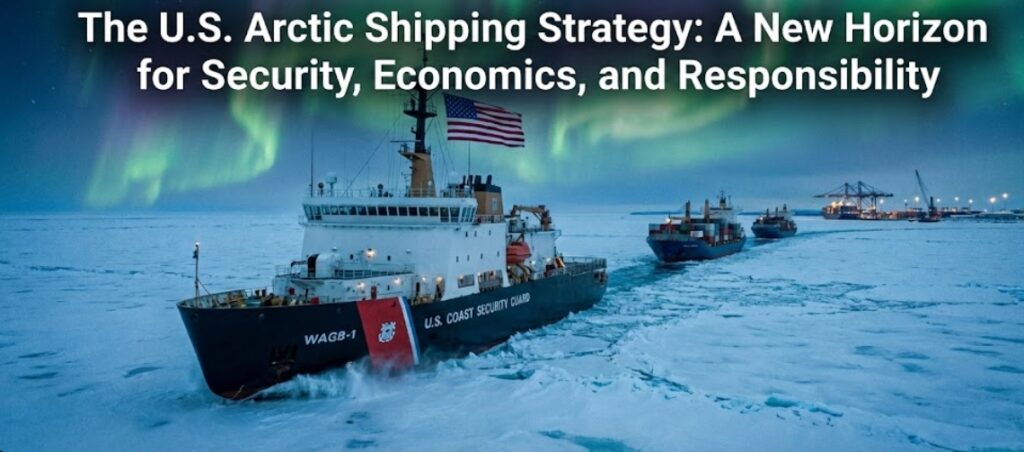

The U.S. Arctic Shipping Strategy: Where Security, Trade, and Climate Collide

The Arctic isn’t just “melting into a shortcut.” For Americans, it’s turning into a real-world test of whether we can defend, compete, and protect a fragile region—at the same time.

When people talk about Arctic sea routes, they often jump straight to the headline: “faster shipping between Asia and Europe.” But from a U.S. perspective, the story is bigger—and honestly, harder.
The Arctic is our northern front door through Alaska. As sea ice retreats and navigation becomes more feasible, the region doesn’t just get “more open.” It gets more crowded, more strategic, and more contested.
That means the United States has to balance three things that don’t always play nicely together: national security, economic opportunity, and environmental responsibility.

1) Why the Arctic matters to the U.S.

For the United States, the Arctic isn’t just a remote frozen map zone—it’s a frontline.
Alaska puts us physically in the Arctic, and as maritime access expands, this region becomes directly tied to homeland defense, NATO’s northern flank, and rules governing navigation.
At the same time, the Arctic’s opening creates new leverage points in global supply chains—especially when traditional chokepoints get disrupted.

That’s why Washington increasingly frames the Arctic as a place where security, economics, and climate collide.
If we show up late—with weak logistics and limited ice-capable capacity—others will shape the standards, costs, and norms.

2) U.S. Arctic policy: the pillars

The U.S. approach treats the Arctic as a multi-domain strategic arena. The Biden administration’s Arctic strategy (2022) emphasizes four themes:
stronger security, climate/environmental protection, sustainable economic development, and international cooperation and governance.

Across administrations, one idea stays consistent: Russia and China’s expanding Arctic posture is viewed as a major strategic challenge.
The U.S. also holds a firm principle that Arctic navigation should remain aligned with freedom of navigation—not controlled by a single gatekeeper.

3) Strategic investments: ships, ports, and tech

Strategy is only real if you can operate safely and consistently in the Arctic. That’s why U.S. efforts focus on three “hard assets”:
ice-capable fleets, northern logistics, and Arctic-domain awareness.

Icebreakers (USCG)
The U.S. Coast Guard is building three Polar Security Cutters (PSC) as the core of a heavy-icebreaker rebuild.
Longer-term assessments often argue the U.S. needs a larger mixed fleet (heavy + medium) to operate credibly at scale.
ICE Pact (U.S.–Canada–Finland)
ICE Pact aims to expand allied cooperation across the full icebreaker lifecycle—design, construction, operations, and sustainment.
It’s as much an industrial capacity play as it is a geopolitical one.
Port of Nome (Alaska)
The Port of Nome deep-draft expansion is designed to become a key northern logistics node—supporting both civilian commerce and operational reach.
In the Arctic, distance is cost, and a northern port changes response time and sustainment.
Arctic tech: satellites, drones, comms, SMRs
Arctic operations demand visibility in darkness and storms—driving interest in SAR satellites, unmanned systems, radar, and resilient communications.
For remote power needs, small modular reactors (SMRs) are often discussed as a potential solution where grids are limited.

4) Economic opportunities: shipping + resources

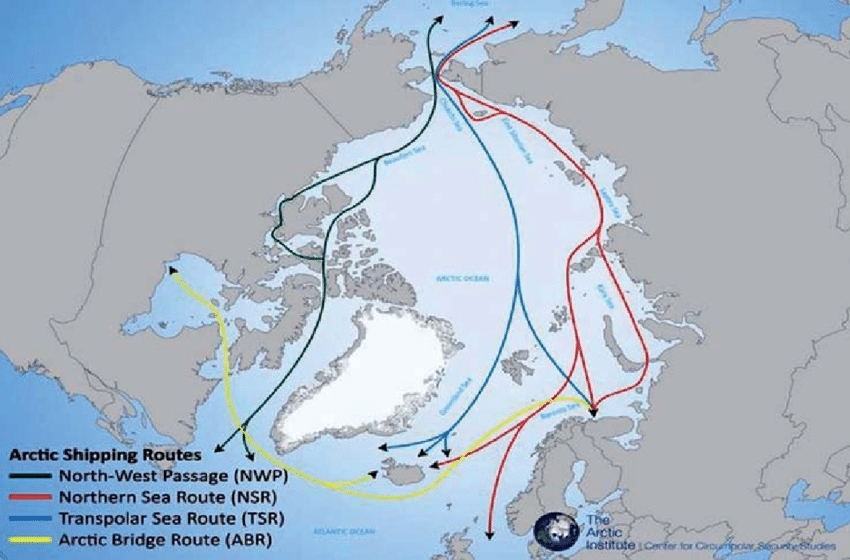
On paper, Arctic routes can shorten some Asia–Europe voyages, potentially cutting transit time and fuel consumption in certain seasons.
But the bigger U.S. economic upside may be “strategic resilience”: extra routing options when other chokepoints break, plus industrial spillovers
from ice-capable shipbuilding, sensors, communications, and cold-weather logistics.

Resources matter too. The Arctic is often cited as rich in hydrocarbons and critical minerals, which connects directly to U.S. energy security and supply-chain diversification.
Projects tied to Alaska (including LNG development discussions) can become part of that broader energy and infrastructure picture.

5) Risks: cost, uncertainty, geopolitics, environment

Here’s the reality check: the Arctic is not a cheap ocean. The navigation window is seasonal, ice conditions can change quickly,
and the economics can be reshaped by insurance premiums, support/escort services, and delays.
Geopolitically, Russia’s strong control claims around the Northern Sea Route can translate into fees, permits, and legal disputes.

Environmentally, the stakes are high. The Arctic is warming much faster than the global average, and shipping can increase black carbon impacts and spill risks.
That’s why fuel restrictions and cleaner propulsion technologies are not “nice extras”—they’re part of whether Arctic shipping is sustainable at all.

6) Responsibility: cooperation and cleaner shipping

For the U.S., “responsibility” in the Arctic has two meanings: working with allies to shape rules and capacity, and taking environmental protection seriously enough
to invest in cleaner shipping and real spill-response readiness.

That’s why partnerships like ICE Pact and broader engagement with Arctic allies matter, and why compliance with IMO-style fuel restrictions pushes innovation
in LNG propulsion, low-carbon fuels, and ice-capable green vessel designs.

Bottom line: The Arctic is opening—so America needs “boring reliability”

If the Arctic becomes a busier ocean, the U.S. shouldn’t just show up with speeches. We need ice-capable ships, ports that can sustain operations,
and the data backbone (satellites, comms, forecasting) that keeps people safe. And we can’t treat the environment as an afterthought.
In the Arctic, climate stability and security are linked—so investing in cleaner fuels, black-carbon reduction, and spill-response readiness is part of competing responsibly.
The question isn’t whether the Arctic will matter. It’s whether we’ll be ready when it does.

keywords: icebreakers, PolarSecurityCutter, Arcticlogistics, SARsatellite, Arcticcommunications, SMR, criticalminerals, lowcarbonfuels

The U.S. Arctic Shipping Strategy: Where Security, Trade, and Climate Collide

The U.S. Arctic Shipping Strategy: Where Security, Trade, and Climate Collide

The U.S. Arctic Shipping Strategy: Where Security, Trade, and Climate Collide The Arctic isn’t just “melting into a shortcut.” For Americans, it’s turning into a real-world test of whether we can defend, compete, and protect a fragile region—at the same time. When people talk about Arctic sea routes, they often jump straight to the headline: […]
/mada

[mandalart_builder]

government bond yields & interest rates

government bond yields & interest rates

Understanding Government Bond Yields: The Hidden Key Behind Economic Trends You keep hearing about “bond yields” in the news—why are they so important anyway? Hi there! With all the buzz around interest rates lately, have you ever wondered what government bond yields actually mean for your daily life? I used to think they were just […]

error: Content is protected !!
Scroll to Top