Abstract
This article examines why space data centers have emerged as a topic of discussion amid the rising electricity demand of terrestrial data centers, cooling costs, water use, land constraints, pressure on power grids, and the growing need to process data generated in space. A space data center refers to the placement of data processing and storage systems for AI and other computing workloads on satellites or orbital platforms. It offers potential advantages such as access to solar power, reduced pressure on terrestrial resources, and proximity to space-generated data. However, when the current technical, economic, environmental, and policy evidence is considered together, space data centers appear more likely to be tested first in limited application areas such as orbital data preprocessing, Earth observation, and space edge computing, rather than serving as a general-purpose cloud infrastructure that can replace terrestrial data centers in the near future. Thermal control, radiation, communications, large-scale assembly, satellite manufacturing and launch costs, orbital debris, spectrum allocation, registration, and liability rules remain key bottlenecks. Therefore, the environmental and economic value of space data centers cannot be judged solely by their potential to reduce water use or access solar power. It must also account for lifecycle launch emissions, orbital environmental burdens, radiator architecture, and regulatory costs. This article argues that space data centers should be recognized as a potential complementary option for future digital infrastructure, but at the present stage they should be understood not as a replacement for general-purpose terrestrial cloud infrastructure, but as a specialized experiment in orbital computing.
Keywords
space data centers, AI infrastructure, data center electricity demand, orbital computing, space edge computing, orbital debris, digital infrastructure
1. Introduction
Data centers are core infrastructure for the digital economy. Cloud services, e-commerce, financial transactions, research data processing, generative AI, and high-performance computing all depend on the storage, computing, and networking capabilities of large-scale data centers. In recent years, however, data centers have moved beyond the domain of information technology facilities and have become central issues in energy, environmental policy, urban planning, and industrial strategy. In particular, as the demand for AI model training and inference expands rapidly, electricity consumption, cooling burdens, water use, land availability, and grid interconnection have all become major concerns.[1]
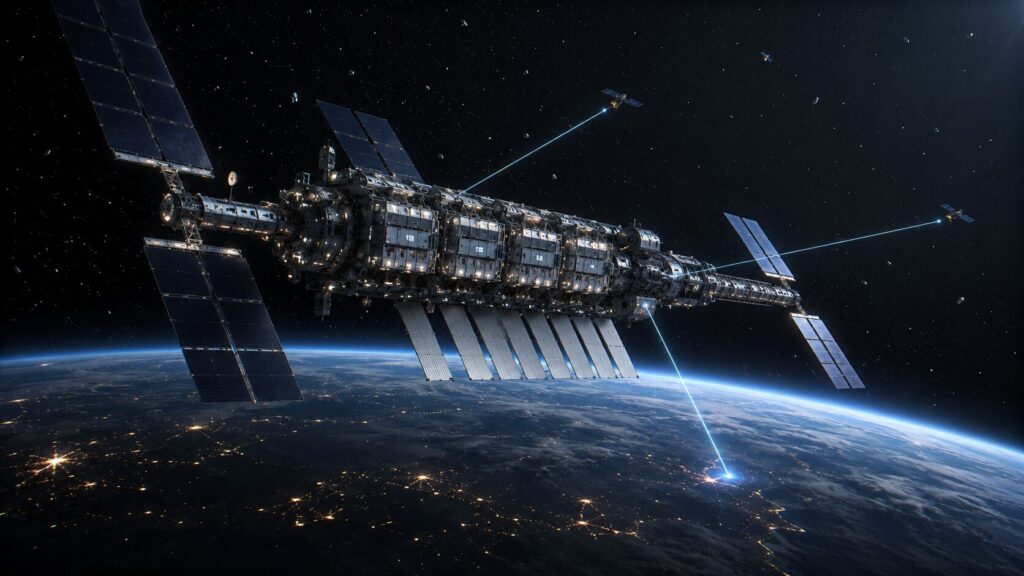
One radical idea that has emerged in this context is the space data center. A space data center is a concept in which computing systems responsible for data processing and storage are placed not in terrestrial facilities, but on satellites or orbital platforms. This is not simply a proposal to move servers into space. Rather, it combines several logics: solar power generation, the radiative thermal environment of space, inter-satellite communication, in-orbit assembly, on-site processing of data generated in space, and the reduction of pressure on terrestrial resources.[2]
The first distinction that must be made in any discussion of space data centers is the difference between “possibility” and “maturity.” As of 2026, feasibility studies, corporate research projects, policy reports, and regulatory filings related to space data centers exist, but large-scale commercial services have not yet been demonstrated.[3] Europe’s ASCEND project examined the feasibility and environmental implications of space-based data centers, while Google’s Project Suncatcher proposed a long-term concept for space-based AI infrastructure using solar-powered satellite constellations and AI accelerators.[4] The U.S. Government Accountability Office has also noted that space data centers could reduce land, electricity, and water demands associated with terrestrial data centers, while emphasizing that significant engineering and economic barriers remain.[5]
The central question of this article is therefore as follows: Are space data centers a realistic substitute for terrestrial data centers, or are they a technical concept that will first be tested in limited application areas? To answer this question, the article reviews the concept of space data centers, their background, potential advantages, technical bottlenecks, economics, environmental implications, legal and policy issues, and 10–30 year outlook. It concludes that while space data centers may become a meaningful complementary layer of digital infrastructure over the long term, the current evidence does not support the claim that they can replace general-purpose terrestrial cloud infrastructure at this stage.
2. Concept and Structural Differences of Space Data Centers
A space data center is a concept in which data processing and storage systems for AI and other computing workloads are placed on satellites or orbital platforms. This definition is not merely about the physical location of server equipment. While terrestrial data centers depend on electric grids, cooling water, cooling systems, fiber-optic networks, human maintenance, and land-use regulation, space data centers depend on solar power generation, radiators, spacecraft thermal control, inter-satellite or ground-to-space communications, in-orbit assembly and replacement, space law, and spectrum coordination. In other words, relocating a data center to space means changing not only its physical site but also the conditions of energy supply, cooling, maintenance, communications, and regulation.
Space data centers can be broadly divided into two types. The first is the orbital edge data center. This model processes or analyzes data generated in space while still in orbit, sending only the necessary information back to Earth rather than transmitting all raw data to the ground. This includes the selection, compression, and first-stage analysis of large datasets generated by Earth observation satellites, space exploration instruments, and satellite constellations. The second is the orbital cloud data center. This model places larger-scale servers and networks in satellite constellations or orbital platforms to provide computing services to terrestrial users or space assets.[6]
Although both models share the premise of space-based computing, they differ significantly in technical difficulty and economic requirements. An orbital edge data center has a clear mission rationale because the data source itself is in space. By processing data on-site and transmitting only analysis results to the ground, it can reduce communication burdens. By contrast, an orbital cloud data center must provide general-purpose computing services to users on Earth, requiring high bandwidth, low latency, stable links, continuous power supply, and long-term hardware reliability. This distinction is important for assessing the likely early applications of space data centers.
Orbit selection is also critical. Low Earth orbit offers relatively lower access costs and lower communication latency with the ground. Sun-synchronous or high-illumination orbits are often presented as attractive for solar power utilization. Google’s Project Suncatcher proposes a satellite-constellation-based AI infrastructure concept that combines solar power generation, free-space optical inter-satellite communication, and AI accelerators.[7] However, the fact that solar power may be more available in a particular orbit does not by itself guarantee the economic or environmental viability of the entire system. Generated power must be stored, converted, and distributed; heat produced during computation must be radiated into space; and data must be exchanged reliably with Earth or other satellites.
3. Background: Pressure on Terrestrial Infrastructure and the Need to Process Space-Generated Data
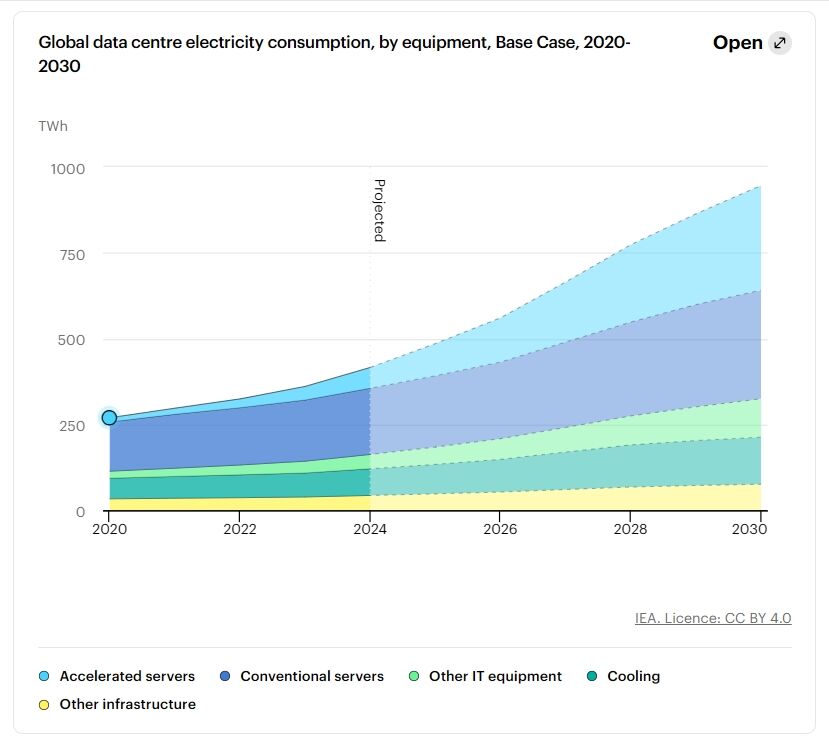
The first driver behind the discussion of space data centers is the rapid growth of data center electricity demand. The International Energy Agency projects that electricity consumption by data centers is increasing quickly alongside the spread of AI, and that global data center electricity consumption could rise substantially by 2030.[8] AI model training and inference are expanding the use of high-performance GPUs, TPUs, and other specialized accelerators, which in turn require high power density and intensive cooling. As a result, data centers are no longer merely an internal facilities issue for technology companies; they are now directly tied to grid planning, regional energy prices, carbon emissions, and industrial siting policy.
The second driver is the bottleneck created by terrestrial siting and electric grids. Data centers require reliable power, sufficient cooling resources, network connectivity, low disaster risk, and regulatory acceptance all at the same time. Locations that satisfy all of these conditions are limited. When data centers concentrate in particular regions, they can trigger transmission-grid expansion needs, power reliability concerns, local opposition, and conflicts over water use. Space data centers are presented as a radical alternative that could bypass some of these terrestrial siting constraints. Yet moving the facility into space does not eliminate resource constraints; rather, those constraints reappear in different forms, including power, heat, communications, and maintenance.
The third driver is the growth of data generated in space. Earth observation, satellite communications, space exploration, and satellite constellation operations all generate large volumes of data. A workflow in which all data are downlinked to ground stations before processing is constrained by bandwidth, latency, and ground-station availability. In this context, a space data center could function not as a replacement for terrestrial data centers, but as orbital edge-computing infrastructure responsible for preprocessing and filtering space data. This use case has a clearer technical and economic rationale than replacing general-purpose cloud services.
4. Potential Advantages
The most intuitive advantage of space data centers is the potential to reduce pressure on terrestrial resources. Terrestrial data centers require land, electricity, cooling water, transmission grids, and cooling systems. By contrast, space data centers are presented as a way to avoid occupying terrestrial land, directly use solar power, and reduce dependence on water cooling.[9] Given that data center cooling water can create political and environmental conflicts in water-stressed regions, the possibility of reducing water-cooling burdens is an important argument.
Second, space data centers are attractive from the perspective of solar power utilization. Terrestrial solar power is affected by weather, nighttime, atmospheric conditions, and seasonal variation, whereas certain orbits can provide relatively long periods of sunlight. In a context where AI computing demand continues to grow, this appears to be an important advantage. However, abundant solar power alone does not make data center operation easy. Power storage, power conversion, server load management, battery life, attitude control, and heat rejection must all be designed together.
Third, space data centers can reduce the distance between where data are generated and where they are processed. Raw data from Earth observation satellites, sensor data from space probes, and status data from satellite constellations are generated in space. Processing them in orbit can reduce the need to transmit all raw data to Earth. This can save communication bandwidth, reduce latency, and support missions that require urgent decision-making. These advantages support the idea that space data centers are likely to become meaningful first in space edge computing rather than in general-purpose cloud computing.
All of these advantages, however, are conditional. The claim that space data centers reduce pressure on terrestrial resources must be evaluated against the costs of launch, manufacturing, replacement, disposal, and the orbital environment. The solar power advantage must be considered alongside thermal-control and communication bottlenecks. The advantage of data-proximate processing applies most directly to data generated in space, while general cloud computing for terrestrial users faces greater constraints in latency and bandwidth.
5. Technical Bottlenecks
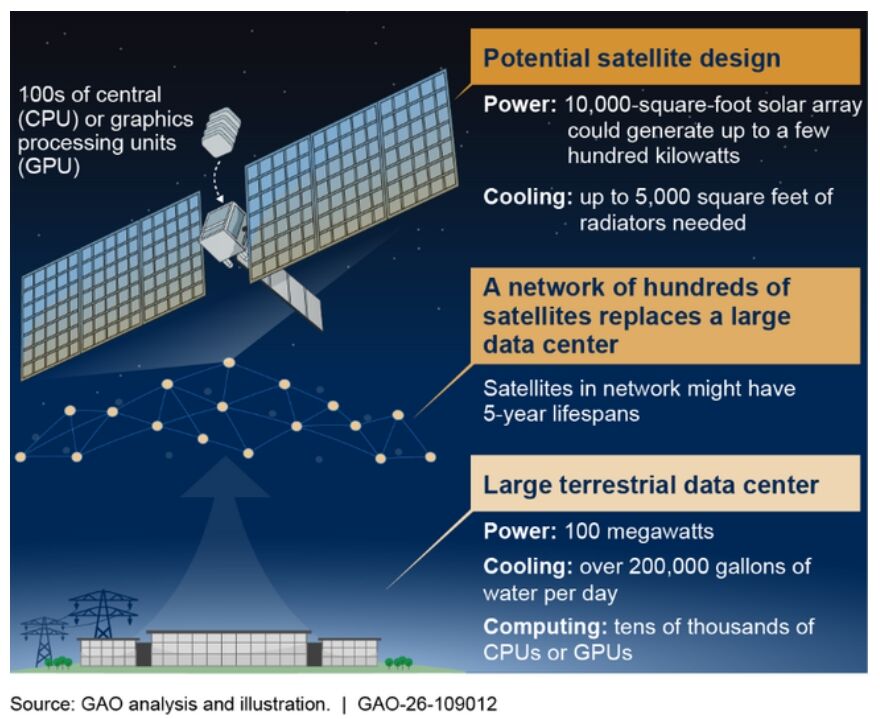
The most important technical bottleneck for space data centers is thermal control. Space is often described casually as “cold,” but in a vacuum, heat cannot be removed by air convection as it is on Earth. A spacecraft’s temperature is determined by the balance among solar radiation, albedo, planetary radiation, internal heat generation, stored heat, and radiative heat rejection.[10] Data-center-class computing equipment continuously generates large amounts of heat, which must be rejected into space through radiators and thermal-control systems. Radiative capacity is constrained by radiator area, emissivity, temperature difference, and orbital conditions.
This problem differs fundamentally from cooling in terrestrial data centers. On Earth, data centers can use a range of methods such as air cooling, liquid cooling, and immersion cooling, and maintenance personnel can directly replace equipment. In space, by contrast, cooling architecture translates directly into additional mass and surface area. Larger radiators increase launch mass and structural complexity, and they can also require larger power and communications systems. Thermal control is therefore not an auxiliary subsystem for space data centers; it is a core factor that shapes both economics and environmental performance.
Radiation is another major constraint. The space radiation environment can cause single-event effects, total ionizing dose damage, and displacement damage in electronic systems. General-purpose server hardware used in terrestrial data centers cannot simply be placed in orbit without modification. Radiation-hardened design, shielding, error correction, redundancy, and replacement strategies are required. These requirements directly affect performance, cost, and mass. Google’s research on space-based AI infrastructure also identifies radiation tolerance of AI accelerators, inter-satellite communications, launch costs, and formation control as major challenges.[11]
Communications are also a decisive bottleneck. If a space data center is to provide general-purpose cloud services to terrestrial users, it must support high bandwidth, low latency, stable links, spectrum coordination, and ground-station infrastructure. Free-space optical communication demonstrates the potential for high-speed inter-satellite links, but technical demonstrations are different from a commercial network operating at data-center scale. Orbital edge computing is better suited to early deployment because it can reduce the communication burden by processing raw data in space and transmitting only necessary results.
Large-scale assembly and maintenance are also unresolved challenges. A large space data center would require solar arrays, radiators, communication equipment, and server modules far larger than those on a single conventional satellite. Launching, assembling, and replacing faulty parts in orbit are not yet routine industrial activities. The technical bottleneck is therefore not a single device-performance issue; it is a system-level problem in which power, cooling, communications, radiation, assembly, maintenance, and orbital operations must all be solved together.
6. Economic Analysis
The economics of space data centers remain highly uncertain. Large space data centers are shaped not only by satellite manufacturing and launch costs, but also by the mass and size constraints added by power, cooling, and communications systems. Larger power systems require more solar panels, batteries, and power-conversion equipment. Higher compute loads require more radiator area and thermal-control hardware. Higher communication requirements add optical communication equipment, RF systems, antennas, ground stations, and spectrum-coordination costs. All of these factors increase launch mass, system complexity, and total cost of ownership.
It is inappropriate to evaluate the economics of space data centers solely by launch cost. Launch price is only one part of total system cost, which also includes spacecraft manufacturing, server hardening, thermal-control systems, communication equipment, integration, insurance, ground stations, operations, replacement, and disposal. A proper comparison with terrestrial data centers would require total-cost-of-ownership analysis under equivalent performance, lifetime, communication requirements, availability, and security standards. Publicly available information is not yet sufficient to support such a comparison.
The central economic question is not simply whether launch costs per kilogram decline, but whether compute resources placed in orbit can generate enough value over their mission lifetime. For a space data center to be economically viable, it must achieve high utilization, long hardware life, low failure rates, low communication costs, sufficient power supply, and stable thermal control during a limited mission lifetime. Replacing general-purpose terrestrial cloud infrastructure would also require low user latency, manageable data-movement costs, continuous availability, and rapid hardware refresh cycles, making the challenge even more difficult.
By contrast, orbital preprocessing and space edge computing may face relatively simpler economic conditions. If the data source is in space and only processed results need to be transmitted to Earth, communication costs and ground-station burdens can be reduced. For mission-specific applications such as Earth observation, space exploration, and autonomous satellite-constellation operations, the economic logic can differ from that of general-purpose cloud computing. Thus, the current economic conclusion is not that space data centers are impossible, but that the cost structure of a general-purpose replacement model has not yet been validated.
7. Environmental Analysis
The environmental implications of space data centers are two-sided. On the positive side, they are presented as a potential way to reduce the water use and land burden of terrestrial data centers. Terrestrial data centers may use water for cooling or require large cooling systems, and they can create challenges related to grid interconnection and land use. Space data centers are environmentally attractive insofar as they could reduce some of these terrestrial burdens.[12]
However, environmental performance cannot be judged by water use alone. Space data centers could create new environmental burdens through launch vehicles, satellite manufacturing, orbital operations, replacement, and disposal. Large satellite constellations in particular could worsen the problem of orbital objects and space debris. The European Space Agency reports that both tracked objects and estimated debris in Earth orbit continue to increase, and that orbital sustainability is already a major concern.[13]
Thermal control is also connected to environmental assessment. In terrestrial data centers, electricity consumption and cooling-water use are major environmental indicators. In space data centers, waste heat must be rejected by radiation. Larger radiator surfaces and structures may increase launch mass and manufacturing burdens. Although the low background temperature of space may seem advantageous, actual heat rejection is constrained by radiator area, emissivity, temperature difference, and orbital environment. Space data centers therefore cannot be judged environmentally superior simply because they do not use water cooling.
Ultimately, the environmental performance of space data centers must be assessed by considering water-use reduction potential, solar power utilization, lifecycle launch emissions, orbital debris, thermal-control architecture, and satellite replacement cycles together. Current evidence shows that space data centers could become environmentally beneficial under certain conditions, but it does not prove that they are already environmentally superior. Their environmental value is a conditional possibility, not a settled conclusion.
8. Legal and Policy Issues
Space data centers are subject to multiple international and national regulatory frameworks. The Outer Space Treaty regime, the Liability Convention, the Registration Convention, long-term sustainability guidelines, orbital debris mitigation rules, and ITU spectrum coordination may all be relevant.[14] While terrestrial data centers are primarily governed by electricity, land-use, environmental, privacy, and cybersecurity regulations, space data centers add issues of space-object registration, launching-state liability, orbital safety, spectrum interference, and international coordination.
Registration and liability are especially important. If space data centers are deployed as satellite constellations or large orbital structures, the registration, function, orbital information, and launching-state responsibility of each space object become key issues. If collisions, reentries, spectrum interference, or debris-generating events occur, questions of liability and compensation may become complex. If a large space data center involves multinational corporations, multiple launching states, several ground stations, and diverse customers, the liability structure becomes even more complicated.
Spectrum and communications regulation are also central. If space data centers communicate with terrestrial users or operate inter-satellite links, they require spectrum allocation, interference prevention, and international coordination. If data-center-scale satellite constellations handle large communication volumes, radio interference, optical communication safety, ground-station licensing, and national data jurisdiction could arise simultaneously. A space data center is therefore not only a space-industry project; it is also a communications-infrastructure project.
Orbital debris regulation may determine the social acceptability of space data centers. Low Earth orbit already contains numerous satellites and debris objects, and large constellations can worsen collision-avoidance and end-of-life disposal challenges. If a space data center is proposed as thousands of satellites or large orbital structures, end-of-mission disposal, collision avoidance, fragmentation prevention, registration and tracking, and liability allocation become essential policy issues. Space data centers are therefore governance projects as much as they are technology projects.
9. 10–30 Year Outlook and Early Use Cases
Over the next 10 to 30 years, the most realistic scenario is not the replacement of general-purpose terrestrial cloud infrastructure, but limited and specialized use. Small or medium-scale orbital computing systems designed to process data generated in space are likely to become viable sooner than large space data centers for AI model training. This is more realistic in terms of technical difficulty, communication requirements, economics, and mission purpose.
Early applications are likely to include Earth observation, space exploration, satellite constellation operations, and space edge computing. Earth observation satellites generate large volumes of imagery, and instead of transmitting all raw data to the ground, they can perform region-of-interest detection, change detection, compression, filtering, and first-stage analysis in orbit. Space exploration also benefits from on-site processing because of communication delay and limited bandwidth with Earth. Satellite constellations may increasingly require inter-satellite data sharing and autonomous decision-making.
In the medium term, advances in solar-powered constellations, optical communications, in-orbit assembly, radiation-tolerant AI accelerators, and automated maintenance could enable larger orbital computing experiments. Research such as Google’s Project Suncatcher illustrates these long-term possibilities.[15] However, for large general-purpose space data centers to compete with terrestrial data centers, they would need to satisfy requirements for thermal control, power storage, communication bandwidth, launch and manufacturing costs, replacement cycles, and regulatory costs. Current official materials and verified evidence show that these conditions remain at the research and demonstration stage, and do not support the conclusion that such systems are already commercially mature.
In the long term, space data centers may become part of a layered digital infrastructure that complements terrestrial systems. Terrestrial data centers would continue to handle large-scale general-purpose computing and data storage, while space data centers would process data generated in space, provide certain orbit-based AI inference capabilities, and support workloads that are less sensitive to latency or costly to move. This complementary scenario is most consistent with the current evidence.
10. Conclusion
Space data centers are a future-oriented digital infrastructure concept that has emerged against the backdrop of rising AI and data center electricity demand, pressure on terrestrial grids, land and water-use constraints, and the need to process data generated in space. They involve placing data processing and storage systems for AI and other computing workloads on satellites or orbital platforms, and they offer potential advantages in solar power utilization, reduced pressure on terrestrial resources, and proximity to space-generated data.
However, the current evidence is not sufficient to evaluate space data centers as an immediate substitute for terrestrial data centers. Thermal control and cooling, radiation, communications, large-scale assembly, launch and manufacturing costs, orbital debris, spectrum regulation, and legal liability all remain significant bottlenecks. Environmental performance in particular cannot be judged solely by potential water-use reduction; it must also consider lifecycle launch emissions, thermal-control architecture, and orbital-debris risks. Economics must likewise account not only for launch prices, but also for system lifetime, utilization, replacement cycles, communication costs, and manufacturing and operating expenses.
The conclusion of this article is therefore as follows. Space data centers may become a complementary layer of digital infrastructure over the long term, but as of 2026 they have not been validated as large-scale commercial services. In the near future, their most realistic applications are likely to appear not as replacements for general-purpose terrestrial cloud systems, but in limited areas such as orbital data preprocessing, Earth observation, and space edge computing. The policy significance of space data centers lies not in declaring them an “escape route” from terrestrial data centers, but in examining the technical, environmental, economic, and governance conditions under which a new computing infrastructure linking Earth and space could be justified.
Endnotes
- The International Energy Agency treats the spread of AI and the rise in data center electricity consumption as major energy-policy issues, and projects that data center electricity demand could increase substantially by 2030. IEA, Energy Demand from AI
- The U.S. Government Accountability Office describes space data centers as the placement of data processing and storage systems for AI and other computing needs on satellites. GAO, Science & Tech Spotlight: Data Centers in Space
- As of 2026, the available materials are closer to feasibility studies, policy reports, corporate research, and planned demonstrations than to verified large-scale commercial operation. GAO, Science & Tech Spotlight: Data Centers in Space
- ASCEND was introduced as a European feasibility study on space-based data centers, while Google’s space-based AI infrastructure research presents a long-term system design combining solar-powered satellite constellations, TPUs, and free-space optical communication. Thales Alenia Space, ASCEND Feasibility Study
- GAO states that space data centers could reduce the land, power, and water use required by terrestrial data centers, but also emphasizes engineering and economic barriers. GAO, Science & Tech Spotlight: Data Centers in Space
- A 2025 paper in Nature Electronics distinguishes between orbital edge data centers and orbital cloud data centers, discussing on-site processing of space-generated data and satellite-constellation-based cloud models. Nature Electronics
- Google researchers’ Project Suncatcher paper presents a concept for space-based AI infrastructure using solar-powered satellite constellations, inter-satellite optical communication, and TPU accelerators. arXiv, Project Suncatcher
- IEA analyzes the rapid increase in data center electricity consumption alongside the spread of AI, identifying data centers as a major driver in electricity demand projections for 2030. IEA, Energy Demand from AI
- GAO notes the possibility that space data centers could reduce the land, electricity, and water use required by terrestrial data centers. GAO, Science & Tech Spotlight: Data Centers in Space
- NASA’s small-spacecraft thermal-control materials explain that spacecraft temperature is determined by the balance of heat absorbed, stored, generated, and rejected, and that all components must remain within allowable temperature ranges. NASA, Thermal Control
- Google’s research on space-based AI infrastructure addresses radiation testing, high-speed inter-satellite communication, close formation flying, and launch cost as major technical and economic variables. arXiv, Project Suncatcher
- ASCEND and GAO materials suggest that space data centers could reduce water use and pressure on terrestrial resources, but this should not be read as proof of environmental superiority. Thales Alenia Space, ASCEND Feasibility Study
- ESA’s 2025 Space Environment Report shows that tracked objects and estimated orbital debris continue to increase, making orbital sustainability a major issue. ESA Space Environment Report 2025
- UNOOSA’s long-term sustainability guidelines provide guidance on policy and regulatory frameworks, operational safety, international cooperation, and scientific and technical research for space activities. UNOOSA, Guidelines for the Long-term Sustainability of Outer Space Activities
- Google’s research explores the long-term possibility of space-based AI infrastructure while also identifying launch cost, communications, radiation, and constellation operations as unresolved challenges. arXiv, Project Suncatcher
References
- Aili, A., Choi, J., Ong, Y. S., & Wen, Y. “The Development of Carbon-neutral Data Centres in Space.” Nature Electronics, 2025. DOI: 10.1038/s41928-025-01476-1. https://www.nature.com/articles/s41928-025-01476-1
- Agüera y Arcas, B., Beals, T., Biggs, M., Bloom, J. V., Fischbacher, T., Gromov, K., Köster, U., Pravahan, R., & Manyika, J. “Towards a Future Space-based, Highly Scalable AI Infrastructure System Design.” arXiv, 2025. https://arxiv.org/abs/2511.19468
- European Space Agency. ESA Space Environment Report 2025. ESA, 2025. https://www.esa.int/Space_Safety/Space_Debris/ESA_Space_Environment_Report_2025
- International Energy Agency. “Energy Demand from AI.” IEA, 2025. https://www.iea.org/reports/energy-and-ai/energy-demand-from-ai
- International Energy Agency. “Executive Summary – Key Questions on Energy and AI.” IEA, 2026. https://www.iea.org/reports/key-questions-on-energy-and-ai/executive-summary
- NASA Small Spacecraft Systems Virtual Institute. “7.0 Thermal Control.” NASA, updated 2026. https://www.nasa.gov/smallsat-institute/sst-soa/thermal-control/
- Thales Alenia Space. “Thales Alenia Space Reveals Results of ASCEND Feasibility Study on Space Data Centers.” 2024. https://www.thalesaleniaspace.com/en/press-releases/thales-alenia-space-reveals-results-ascend-feasibility-study-space-data-centers-0
- U.S. Government Accountability Office. Science & Tech Spotlight: Data Centers in Space. GAO-26-109012, 2026. https://www.gao.gov/products/gao-26-109012
- United Nations Office for Outer Space Affairs. Guidelines for the Long-term Sustainability of Outer Space Activities. UNOOSA, 2019/2021. https://www.unoosa.org/documents/pdf/PromotingSpaceSustainability/Publication_Final_English_June2021.pdf