
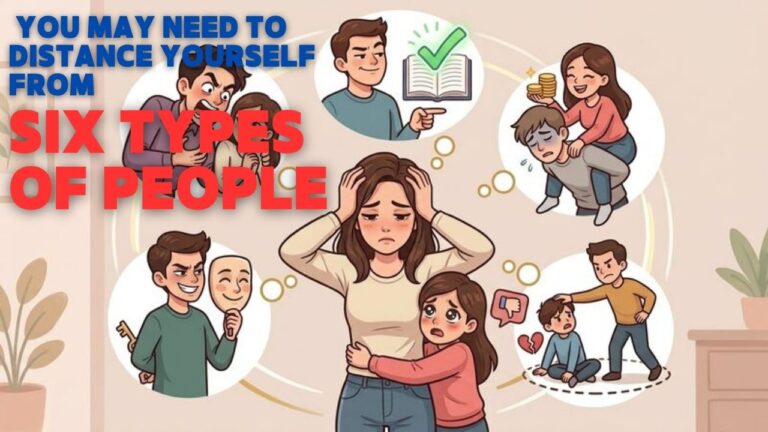
Six Types of People You May Need to Distance Yourself From
Pay attention to repeated behavior, not just words
Look at Repeated Behavior, Not Just Words
Some relationships make us feel more at ease the longer they continue. Others gradually leave us anxious, exhausted, and less confident. When evaluating a relationship, the goal is not to diagnose another person or attach a personality label to them. What matters more is identifying which behaviors keep recurring, how those behaviors affect you, and whether the boundaries you express are respected.
Everyone makes mistakes. Everyone has moments of anxiety or sensitivity, and most people will occasionally react emotionally or fail to keep a promise. For that reason, a single behavior, one mistake, or a temporary emotional reaction is not enough to conclude that someone should be avoided.
What matters is whether the same behavior keeps happening, whether the other person accepts responsibility when the issue is raised, whether they respect your boundaries, and whether their actions genuinely change. A relationship may recover when someone apologizes after a mistake and makes a sincere effort to adjust. By contrast, if expressing discomfort only leads to more blame and pressure, if the same behavior continues after repeated apologies, and if anxiety, guilt, inhibition, and exhaustion accumulate as the relationship continues, the situation may be closer to a recurring harmful pattern than an ordinary mistake.
The following six patterns deserve particular attention in relationships.

1. People Who Manipulate Emotions and Shift Blame
This type of person uses guilt, anxiety, or pity to influence others. When a problem arises, they focus only on the other person’s reaction rather than their own conduct, and they shift responsibility for their words and choices onto someone else.
Common Repeated Behaviors
- They refuse to take responsibility for their anger or behavior and say things such as, “You made me do this.”
- When confronted, they focus on the other person’s tone or reaction rather than the original problem.
- After becoming angry, they justify insulting or threatening behavior by claiming that the other person caused it.
- When a request is refused, they accuse the other person of being selfish or cold.
- When their wrongdoing is pointed out, they suddenly behave as though they are the greater victim.
- They use tears, silence, anger, or anxiety to change the other person’s decision.
- They repeatedly bring up favors they performed in the past to create guilt.
- They make other people responsible for their own choices and actions.
Why This Deserves Caution
Feeling angry because someone has done something wrong can be a natural response. The problem is not anger itself, nor is it the mere expression of anger. The concern arises when a person repeatedly uses anger to justify insults or threats and then places full responsibility for that conduct on the other person.
In this kind of relationship, you may gradually begin to believe that you are responsible for the other person’s emotions. Whenever they become angry or disappointed, you may feel as though you have done something wrong, making it increasingly difficult to refuse demands you do not want to accept.
Expressing emotion is not inherently wrong. The problem begins when emotion is repeatedly used not as information for honest dialogue, but as a tool for controlling another person.
Anyone may show one or more of these behaviors on occasion. The key question is whether emotional pressure and blame-shifting keep recurring and whether they leave you in a continuing state of guilt or anxiety.
Effects on the Relationship
- You begin to question your own judgment.
- You feel excessive guilt when saying no.
- You monitor the other person’s mood before considering your own needs.
- You feel responsible for repairing every conflict.
- You remain emotionally tense and become easily exhausted.
- You gradually place your own needs and choices last.
What to Consider
Notice whether the other person can move from emotional expression to dialogue and adjustment. If they refuse to acknowledge their own responsibility and use emotional pressure only to obtain the outcome they want, caution is warranted.

2. People Who Always Need to Be Right and Superior
This type of person treats conversation not as a process of mutual understanding, but as a contest to determine who is right and who is wrong. In relationships, they value superiority and control more than mutual respect.
Common Repeated Behaviors
- They immediately dismiss different opinions as wrong.
- They frequently interrupt others during conversations.
- They treat apology or compromise as defeat.
- They believe their own experience and standards are the only correct ones.
- They turn even minor disagreements into battles they must win.
- They mock or dismiss the other person’s views.
- They minimize information that is inconvenient for them.
Why This Deserves Caution
Conversations with such a person often become power struggles rather than efforts to solve a problem. When someone is almost never willing to consider that they may be wrong, the other person eventually learns to remain silent or give in.
Differences of opinion are natural in any relationship. The problem is a refusal to recognize that another perspective may have legitimacy.
If conversations consistently leave behind a sense of victory or defeat rather than mutual understanding, the relationship may already be functioning more like a competition than a partnership.
Effects on the Relationship
- You worry about the other person’s reaction before speaking.
- You begin to hide your opinions.
- You leave conversations feeling unheard.
- The same person ends up apologizing after every conflict.
- The relationship becomes more competitive than cooperative.
- You may lose confidence in your judgment and ability to express yourself.
What to Consider
Consider whether the person can listen to a different view, acknowledge the possibility that they may be wrong, and reach a compromise after conflict. A healthy relationship is difficult to maintain when every conversation is treated as a contest with a winner and a loser.

3. People Who Treat Others as Tools
This type of person sees others less as human beings deserving mutual respect and connection and more as instruments for satisfying personal needs.
In psychology, the term Machiavellianism is sometimes used to describe traits associated with self-interest, manipulation, deceptive interpersonal styles, and the pursuit of personal gain.¹ Research on the Dark Triad has likewise treated deception and exploitative interpersonal behavior as important subjects.²
More important than any label, however, is what repeatedly happens in the actual relationship. If someone approaches you only when they need something, uses your information, money, connections, or abilities, and changes their attitude after receiving help, it may be time to reassess the relationship.
Common Repeated Behaviors
- They contact you only when they need a favor.
- They show interest mainly in your abilities, connections, money, or information.
- Their attitude changes after they receive help.
- When you are struggling, they avoid you by saying they are too busy.
- They use emotional closeness to make unreasonable demands.
- They exploit your weaknesses or secrets for their own benefit.
- They prioritize personal gain over reciprocity in the relationship.
Why This Deserves Caution
In such a relationship, you may become unsure whether you are respected as a person or valued only for the function you provide. It becomes difficult to tell whether the other person’s attention is sincere or merely driven by need, and reciprocity begins to disappear.
A long history does not automatically make a relationship mutual. If you are always giving while the other person appears only when something is needed, the connection may be closer to exploitation than genuine closeness.
Effects on the Relationship
- You feel used.
- You fear that refusing a request will end the relationship.
- You place the other person’s needs ahead of your own.
- You receive little support when you are the one in difficulty.
- Trust and emotional security decline.
- You may begin to find it difficult to trust people in general.
What to Consider
Ask whether the person remains interested in you regardless of what you can provide. Do they maintain the relationship when they need nothing from you? Are they willing to stand by you responsibly when you are struggling? These questions matter.

4. People Who Undermine Self-Esteem and Violate Boundaries
This type of person repeatedly belittles others under the guise of humor, advice, or concern. They also dismiss limits involving refusal, privacy, time, and emotion, placing their own demands first.
Common Repeated Behaviors
- They frequently mock your appearance, abilities, or personality.
- They say, “It was just a joke. Why are you so sensitive?”
- They disregard your choices while claiming to give advice.
- They continue making the same demand after you have said no.
- They ask for or share private information without permission.
- They become angry when you decline contact or a meeting.
- They dismiss you even after you clearly say that something is uncomfortable.
- They repeatedly make comparisons that weaken your confidence.
Why This Deserves Caution
Repeated belittling can gradually damage a person’s confidence. What initially appears to be harmless teasing may, over time, make you question your own feelings and judgment.
Boundary violations can have a similar effect. Your sense of authority over your time, emotions, and privacy becomes weaker, and even expressing discomfort may begin to feel like wrongdoing.
When you repeatedly hear, “You are just too sensitive,” attention shifts away from the harmful conduct and toward doubts about your own reaction. Yet whether something is “a joke” should not be determined solely by the speaker’s intention. It also matters whether the listener is repeatedly hurt.
Effects on the Relationship
- Your self-esteem declines.
- You frequently doubt your appearance and abilities.
- You laugh things off even when you feel uncomfortable.
- Saying no becomes increasingly difficult.
- You feel intimidated and tense around the person.
- Your privacy and freedom of choice diminish.
- You may become excessively sensitive to other people’s evaluations.
What to Consider
If someone’s words repeatedly harm your feelings and self-esteem, their claim that they were “only joking” does not necessarily excuse the lack of respect. You may need to draw a clear boundary.
- “It may be a joke to you, but I find it hurtful and offensive. Please do not speak to me that way again.”
- “The main issue is not whether I am sensitive. The problem is that I clearly told you I was uncomfortable, and you continued. I am ending this conversation because it is not respectful.”
What matters most is how the other person responds after hearing that you are uncomfortable. Do they apologize and change their behavior, or do they accuse you of being overly sensitive and repeat the same conduct?
If the person is being blatantly rude, you may respond with calm firmness—and, when appropriate, a touch of humor: “You seem very comfortable crossing boundaries. Apparently, geometry class did not teach you much about lines.”
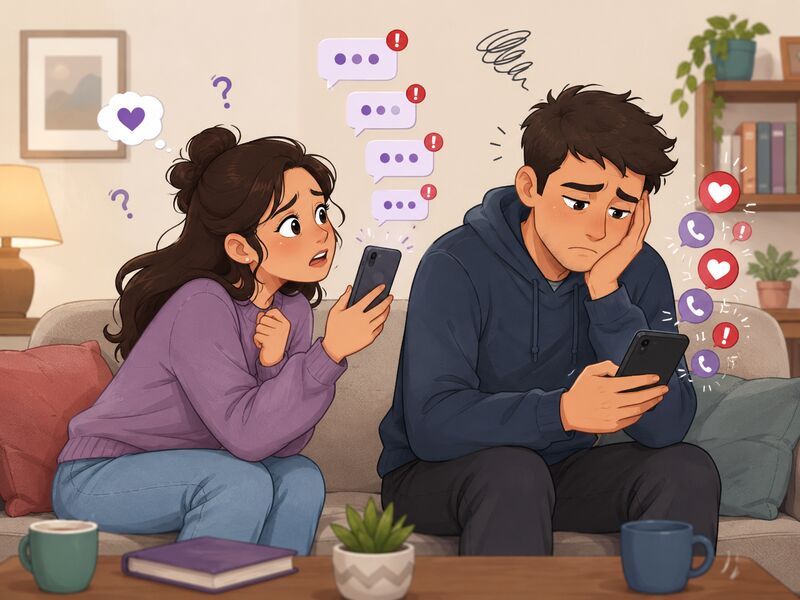
5. People Who Are Overly Dependent and Transfer Emotional Responsibility
This type of person demands continuous reassurance, comfort, explanation, and attention in the name of intimacy. Feeling anxious is natural, but a relationship can become exhausting when one person repeatedly makes the other responsible for relieving that anxiety.
Attachment anxiety and excessive reassurance seeking have been studied in romantic relationships.³ Research has also suggested that attachment anxiety, worry, and difficulty tolerating uncertainty may be associated with threat-related reassurance seeking.⁴
Regardless of the research, the practical standard is clear. If one person must continually explain, soothe, and prove themselves just to keep the relationship intact, emotional responsibility may have become heavily one-sided.
Common Repeated Behaviors
- When you reply late, they repeatedly ask whether you no longer love or care about them.
- They constantly try to monitor whom you are meeting.
- Even after receiving reassurance, they quickly become suspicious again.
- They use their anxiety to restrict your relationships with other people.
- If you do not soothe them, they accuse you of being indifferent or cruel.
- They find it extremely difficult to make decisions or regulate emotions independently.
- They continually monitor your daily life in order to manage their own anxiety.
Why This Deserves Caution
Understanding and comforting a partner’s anxiety can be an important part of a relationship. However, when one person must continually explain, reassure, and prove themselves, the relationship loses its balance.
The crucial question is not whether anxiety exists, but who is expected to take responsibility for managing it.
Effects on the Relationship
- You feel required to explain your messages and schedule constantly.
- You reduce your own activities to avoid triggering the other person’s anxiety.
- You become cautious about seeing friends or family.
- You continuously check the other person’s mood.
- You feel helpless because no amount of explanation seems sufficient.
- The relationship begins to feel more like an obligation than love.
- You become emotionally exhausted and lose freedom.
What to Consider
When you establish a boundary, notice whether the other person tries to manage their anxiety independently. If they continually demand that you solve their emotions for them or use anxiety as a reason to control you, it may be necessary to adjust the distance in the relationship.

6. People Whose Words and Actions Repeatedly Conflict
This type of person frequently makes reassuring statements and promises but rarely follows through. They apologize, yet repeat the same behavior. They change their story depending on the situation while avoiding responsibility.
Research on deception and exploitative interpersonal behavior provides useful background for understanding why repeated actions deserve more weight than words in relationships.² In everyday life, however, the principle is simple: look for genuine change after an apology or promise.
Common Repeated Behaviors
- They say, “It will never happen again,” but the same problem returns.
- They make promises frequently but fail to keep them.
- They tell different stories to different people.
- They appear to admit wrongdoing, yet their behavior does not change.
- Their attitude changes only when they fear losing the relationship.
- Once the immediate problem passes, they return to their previous behavior.
- They apologize quickly but take no responsible follow-up action.
Why This Deserves Caution
When words and actions repeatedly conflict, trust—the foundation of a relationship—begins to collapse. You become unsure whether to believe what the person says or what their behavior shows, and the cycle of hope and disappointment continues.
The purpose of an apology is not merely to end a conflict temporarily. Without behavioral change, an apology may become little more than a way of preserving the relationship without taking responsibility.
Effects on the Relationship
- You find it difficult to trust their promises.
- Hope for change and disappointment repeat in cycles.
- You must explain the same problem again and again.
- You are expected to show increasing patience just to maintain the relationship.
- You begin to search for hidden motives rather than taking words at face value.
- You may find it difficult to trust people in other relationships as well.
What to Consider
The question is not whether someone failed to keep a promise once. The important question is whether their behavior changes after an apology. Consistent action is a more reliable standard than reassuring words.
How to Decide Whether to Create Distance
Seeing one of these six patterns does not mean that you must immediately end a relationship. It is important to consider the following factors together.
- Does the behavior repeat? Determine whether it was a single mistake or a pattern that appears whenever similar situations arise.
- Does the person accept responsibility? Consider whether they acknowledge the effect of their behavior and make a genuine effort to change.
- Do they respect boundaries? Notice whether they accept refusal or discomfort, or instead increase blame and pressure.
- Do words and actions match? Check whether apologies and promises lead to actual change.
- Is the burden concentrated on one person? Ask whether only one person is continually explaining, apologizing, compromising, and soothing emotions.
- How are you changing within the relationship? If you frequently feel anxious, exhausted, guilty, or less confident after interacting with the person, do not dismiss the effect of the relationship.
Documentation Matters Even More at Work
Recurring harmful behavior can appear not only in private relationships but also in the workplace. According to a Segye Ilbo report citing South Korea’s Ministry of Employment and Labor, reported cases of workplace harassment increased from 5,823 in 2020 to 7,774 in 2021, 8,961 in 2022, and 10,028 in 2023.⁵
These figures were taken from a media report that cited the ministry; they were not independently cross-checked here against the ministry’s original dataset. Even so, they illustrate that repeated violations within workplace relationships continue to be raised as an organizational problem.
Power differences can make it more difficult to reject harmful behavior at work. If repeated insults, blame-shifting, unreasonable instructions, public criticism, or information control occur, document the date, specific statement or instruction, participants, and outcome. When necessary, consider internal organizational procedures or external support systems.
How to Create Distance
Creating distance does not always mean ending a relationship completely. Depending on the situation, you can adjust its scope and intensity.
- Reduce the frequency of contact.
- Share less personal information.
- Avoid financial transactions and important favors.
- Limit the duration and subject of conversations.
- Keep records of important promises or agreements.
- If the situation is difficult to manage alone, tell someone you trust.
- At work, document statements, instructions, dates, and circumstances.
- If threats or control become severe, consider seeking formal assistance.
If the same behavior continues after you have clearly expressed a boundary, a firmer adjustment in distance may be necessary.
I Can Also Become One of These People
The purpose of this article is not to classify others casually or label them as people to avoid. Examining harmful behaviors in relationships should also prompt us to reflect on our own conduct. Have I ever demanded excessive reassurance because I felt anxious? Have I shifted responsibility because I was angry? Have I damaged someone’s self-esteem under the guise of humor or advice?
What matters more than the fact that a harmful behavior occurred once is whether we recognize it, accept responsibility, and make an effort to change. Healthy relationships are not created by perfect people. They are built through mutual respect for boundaries, reflection on how our behavior affects others, and ongoing efforts to reduce recurring problems.
Conclusion
The standard for deciding whom to distance yourself from is not a personality label or a diagnosis. What matters is which behaviors repeat and how those behaviors affect you and the relationship.
People who manipulate emotions and shift blame can intensify guilt and anxiety. Those who always need to be right turn conversation into a power struggle. Those who treat people as tools destroy reciprocity. Those who undermine self-esteem and violate boundaries make others feel smaller. Those who are excessively dependent concentrate emotional responsibility on one person. Those whose words and actions repeatedly conflict undermine trust.
Everyone makes mistakes. But when the same behavior continues, responsibility is denied, and boundaries are ignored, it may be time to reconsider the distance you maintain in the relationship.
Look beyond words and labels. Pay attention to repeated behavior. If you are becoming increasingly anxious, exhausted, and disconnected from yourself within a relationship, do not ignore that signal.
Healthy relationships are not built simply by avoiding harmful people. When we begin by respecting other people’s emotions and boundaries and working to become trustworthy ourselves, we are more likely to attract and retain people with similar values. Much like the principle that we tend to resemble the average of those closest to us, the overall quality of our relationships rises when we value healthy people and grow alongside them. A strong network of respectful relationships helps us recognize harmful patterns earlier and protects us from remaining too long in relationships that repeatedly cause damage.
Endnotes
1. Schade, Voracek, and Tran discuss Machiavellianism in the context of personality traits associated with self-interest, deceptive interpersonal styles, and a cynical view of morality. Because the study was conducted in the context of cyberbullying, its findings should not be generalized directly to all interpersonal relationships.
2. Jones and Paulhus discuss how the personality traits that constitute the Dark Triad may be associated with deceptive and exploitative interpersonal behavior through different motives and mechanisms.
3. Shaver, Schachner, and Mikulincer examined the relationships among attachment style, excessive reassurance seeking, relationship processes, and depression in the context of romantic couples.
4. Clark and colleagues analyzed the relationships among attachment anxiety, worry, intolerance of uncertainty, and threat-related reassurance seeking.
5. Segye Ilbo, citing South Korea’s Ministry of Employment and Labor, reported that workplace harassment complaints increased from 5,823 in 2020 to 7,774 in 2021, 8,961 in 2022, and 10,028 in 2023.
References
Clark, G. I., Rock, A. J., Clark, L. H., & Murray-Lyon, K. (2020). Adult attachment, worry and reassurance seeking: Investigating the role of intolerance of uncertainty. Clinical Psychologist, 24(3), 294–305. https://doi.org/10.1111/cp.12218
Jones, D. N., & Paulhus, D. L. (2017). Duplicity among the Dark Triad: Three faces of deceit. Journal of Personality and Social Psychology, 113(2), 329–342. https://doi.org/10.1037/pspp0000139
Schade, E. C., Voracek, M., & Tran, U. S. (2021). The nexus of the Dark Triad personality traits with cyberbullying, empathy, and emotional intelligence: A structural-equation modeling approach. Frontiers in Psychology, 12, 659282. https://doi.org/10.3389/fpsyg.2021.659282
Shaver, P. R., Schachner, D. A., & Mikulincer, M. (2005). Attachment style, excessive reassurance seeking, relationship processes, and depression. Personality and Social Psychology Bulletin, 31(3), 343–359. https://doi.org/10.1177/0146167204271709
Segye Ilbo. (2024, April 8). “Workplace Harassment Complaints Exceeded 10,000 for the First Time in 2023.”
Back to top