China’s Rare Earth Controls and the Reorganization of Non-Chinese Supply Chains
Abstract
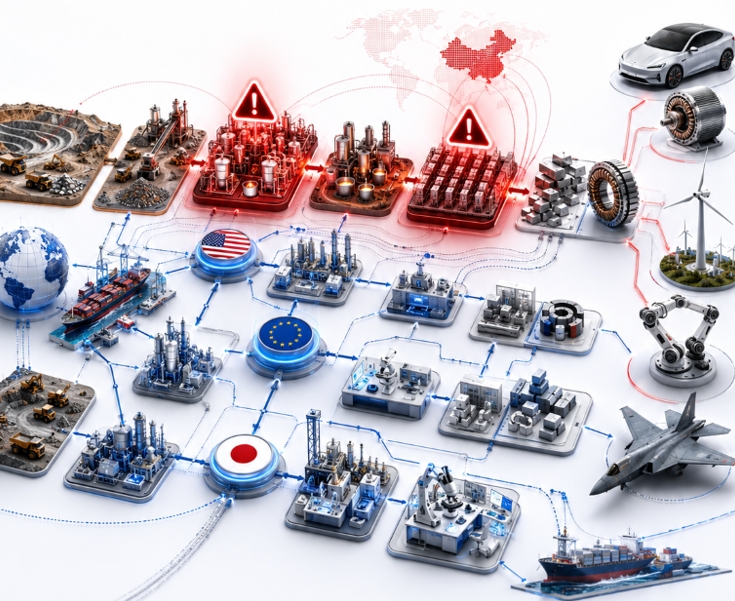
This paper analyzes China’s rare earth export controls and the reorganization of non-Chinese supply chains from the perspective of bottlenecks in refining, separation, and permanent magnet manufacturing. Discussions of rare earth supply chains are often understood as matters of mine development or reserve acquisition, but industrial vulnerability becomes more pronounced in the post-mining stages of refining and separation, metal and alloy production, and sintered NdFeB permanent magnet manufacturing. The International Energy Agency assessed that in 2024 China accounted for 60% of mining production of magnet rare earths and 91% of refined output, and that its share of permanent magnet production was even higher than its share of refined output. China also exported 58,000 tonnes of rare earth magnets in 2024. [1] This shows that the core risk in the rare earth supply chain lies not merely in securing minerals, but in the concentration of refining, separation, and high-performance magnet manufacturing capabilities. China’s rare earth export controls in 2025 transformed this structural vulnerability into a policy risk. On April 4, 2025, China’s Ministry of Commerce and General Administration of Customs implemented export controls on certain medium and heavy rare earths and related permanent magnet items. [2] Subsequently, in October 2025, expanded measures were announced requiring certain overseas organizations and individuals to obtain a dual-use export license from China’s Ministry of Commerce before exporting related rare earth items to countries or regions outside China. [3] However, these October measures were suspended from November 7, 2025, to November 10, 2026. [4] Therefore, this paper does not regard the October 2025 measures as expanded controls currently in force, but interprets them as a suspended potential policy risk. Non-Chinese responses can be summarized along four axes. First, the United States is pursuing the construction of a so-called mine-to-magnet supply chain, anchored by defense demand and extending from mining to magnet manufacturing. The U.S. Geological Survey reported that rare earths were mined and processed in the United States in 2025 and estimated U.S. mineral concentrate production, expressed in rare earth oxide equivalent, at 51,000 tonnes. [5] However, this production base does not immediately imply high-performance magnet manufacturing capability; rather, the U.S. strategy should be understood as an attempt to connect the bottlenecks of refining, separation, and magnet manufacturing in stages, centered on defense-industry demand. Second, the European Union institutionalized, through the Critical Raw Materials Act, targets for 2030 of 10% domestic extraction, 40% processing, and 25% recycling, as well as a target to reduce dependence on any single third country. [6] Third, Japan is pursuing both long-term heavy rare earth offtake and technologies that reduce heavy rare earth usage. [7] Fourth, non-Chinese companies such as MP Materials, E-VAC, and Proterial form the implementation axis of supply-chain reorganization through investment, production-line construction, and materials technology development. [8] However, these movements do not yet amount to a completed alternative supply chain. Publicly verifiable evidence remains limited with regard to long-term price time series, country-level permanent magnet import statistics, Vietnam’s policy and processing capacity, and confirmed production capacity by company. Accordingly, this paper evaluates the reorganization of non-Chinese rare earth supply chains not as “the completion of decoupling from China,” but as “a process of dispersing bottlenecks in refining, separation, and high-performance permanent magnet manufacturing while prioritizing the protection of critical demand.”Key Findings
- Core supply-chain vulnerability: Rare earth risk arises more strongly from the concentration of refining, separation, and high-performance permanent magnet manufacturing than from mining itself.
- Export-control risk in 2025: The April controls should be distinguished as a direct risk that remains in force, while the October expanded measures should be regarded as a potential risk suspended until November 10, 2026.
- Non-Chinese responses: The United States is pursuing a defense-demand-based mine-to-magnet strategy, the EU is advancing CRMA-based benchmarks, and Japan is combining long-term heavy rare earth supply security with reduction technologies.
- Nature of the current phase: The reorganization of non-Chinese supply chains is not the completion of decoupling from China, but rather a risk-management process aimed at dispersing bottlenecks and protecting critical demand.
Analytical Framework
This paper analyzes the rare earth supply chain by dividing it into mining, processing, refining and separation, metal and alloy production, the manufacturing of high-performance sintered neodymium-iron-boron magnets (hereafter, sintered NdFeB permanent magnets), and final industrial demand. It distinguishes between the legal status and industrial significance of policy measures, and interprets corporate announcements by separating them into stages such as planning, investment, construction, and mass production.Value Chain and Bottleneck Structure by Stage in the Rare Earth Supply Chain
In 2024, China accounted for 60% of mining production of magnet rare earths. This is the starting point for raw material diversification outside China, but this stage alone does not secure supply-chain stability.[1]
In 2024, China accounted for 91% of refined output of magnet rare earths. This stage is difficult to replace in a short period because it combines chemical processing, environmental regulation, and accumulated process experience.[1]
This is the intermediate stage in which refined rare earth oxides are converted into metals and functional alloys suitable for magnet manufacturing. The performance and quality stability of final magnets are closely connected to this stage.
China’s share of permanent magnet production is assessed to be even higher than its share of refined output of magnet rare earths. In 2024, China exported 58,000 tonnes of rare earth magnets.[1]
This stage is connected to electric vehicle traction motors, offshore wind generators, electronic components, advanced motors and drive systems, and defense systems such as the F-35 and unmanned aerial vehicles.[7][9][10]
1. Introduction
1.1 Research Background
Rare earths are recognized as critical inputs for advanced manufacturing industries such as electric vehicles, wind power generation, electronic devices, robotics, aerospace, and defense. Rare earths are not resources used only for a single industrial purpose; they are utilized in various fields, including catalysts, abrasives, phosphors, batteries, glass additives, ceramics, and metal alloys. However, this paper focuses its analysis on permanent magnets, particularly sintered neodymium-iron-boron magnets, or sintered NdFeB permanent magnets. This is because permanent magnets are a high-value-added application area among the many uses of rare earths and are most directly connected to strategic industries such as electric vehicle traction motors, wind turbines, robots, aerospace, and defense. Sintered NdFeB magnets are widely used in high-performance motors and drive systems because of their strong magnetic force and high energy density. The U.S. Department of Energy describes NdFeB magnets as the strongest commercially available magnets and analyzes their use in consumer and industrial electronics as well as advanced motors and drive systems. [9] In other words, permanent magnets are the point at which rare earths are transformed from simple raw materials into critical components that determine competitiveness in electrification, automation, defense, and manufacturing. Because of these characteristics, the rare earth supply-chain issue expands beyond a simple question of mineral procurement into a matter of advanced manufacturing and economic security. Nevertheless, general discussions of rare earth supply chains are often reduced to competition over securing mines. Rare earth reserves and mine production are, of course, important, but industrial vulnerability becomes more apparent in the stages after mining. After rare earth ore is mined, it must go through processing, refining and separation, metal and alloy production, and magnet manufacturing before it can be used in final industries. In particular, rare earth elements have similar chemical properties, making separation processes complex, while high-performance magnet manufacturing requires quality control and process know-how. Therefore, when evaluating supply-chain stability, it is necessary to consider not only whether mineral concentrate has been secured but also capabilities in refining, separation, and magnet manufacturing. In this respect, permanent magnets are an appropriate object for analyzing the structural vulnerabilities of the rare earth supply chain. In the magnet rare earth supply chain, China’s dominance is stronger in the refining, separation, and magnet manufacturing stages than in the mining stage. [1] Permanent magnets are therefore a key case that reveals where rare earth supply-chain risks arise and why the reorganization of non-Chinese supply chains cannot be achieved through mine development alone. China’s dominance in the rare earth supply chain has structural significance precisely at this point. The International Energy Agency reported that in 2024 China accounted for 60% of mining production of magnet rare earths, but 91% of refined output. [1] The gap between 60% in mining and 91% in refining shows that even if non-Chinese countries secure mines, limited refining and separation capacity may constrain supply-chain self-reliance or risk diversification. Furthermore, China’s share of permanent magnet production is assessed to be even higher than its share of refined output of magnet rare earths. [1] This suggests that China’s advantage does not end with raw material production but becomes stronger as the supply chain moves toward high-value-added manufacturing stages. The strategic importance of the rare earth supply chain became even more prominent with China’s export controls in 2025. On April 4, 2025, China’s Ministry of Commerce and General Administration of Customs implemented export controls on certain medium and heavy rare earths and related permanent magnet items. [2] This measure showed that rare earths can be used not merely as commodities but as instruments of economic security and industrial policy. Subsequently, in October 2025, expanded measures were announced requiring overseas organizations and individuals exporting related rare earth items outside China to obtain a dual-use export license from China’s Ministry of Commerce. [3] However, because those October measures were suspended from November 7, 2025, to November 10, 2026, they should not be characterized as measures currently in force. [4] However, the suspension of the October expanded measures does not mean that supply-chain risk has disappeared. The April 2025 controls remain in force, and the possibility of delays or denials in export licensing continues to affect corporate and government decision-making. The International Energy Agency assessed that prolonged delays or denials of rare earth magnet export licenses could pose risks to the revenue, competitiveness, and employment of global industrial value chains. [1] In this way, supply-chain risk is not determined solely by whether exports are actually banned. Uncertainty in licensing procedures, the possibility of policy changes, the cost of building alternative supply chains, and corporate inventory strategies all function as drivers of supply-chain reorganization. The responses of non-Chinese countries can be understood as reactions to these structural and policy risks. The United States is pursuing the construction of a mine-to-magnet supply chain centered on defense demand. The U.S. Department of Defense explains that rare earth permanent magnets are essential components of the F-35, unmanned aerial vehicles, and multiple defense systems. [10] The United States is also seeking to build a supply chain that meets defense demand based on its domestic mining and processing base. [5] The EU seeks to reduce dependence on a single third country by setting targets under the Critical Raw Materials Act for domestic extraction, processing, and recycling by 2030. [6] Japan is pursuing both long-term supply security for heavy rare earths and the development of technologies that reduce heavy rare earth usage. [7] At the corporate level, MP Materials, E-VAC, Proterial, and others are forming the implementation units of supply-chain reorganization through investment, production-line construction, and technology development. [8] However, this reorganization does not immediately mean the replacement of China. Non-Chinese countries possess mining bases, policy goals, defense demand, and corporate investment, but there is limited evidence that China’s concentration in refining, separation, and high-performance magnet manufacturing can be reduced in the short term. In particular, corporate announcements include many different stages, such as plans, investments, production-line construction, and products under development or mass production, and therefore should not be interpreted as confirmed production capacity. Supply-chain reorganization has already begun, but its character is closer to a process of gradually dispersing core bottlenecks than to a completed decoupled supply chain.1.2 Research Purpose and Research Questions
The purpose of this paper is to analyze China’s rare earth controls and the reorganization of non-Chinese supply chains from the perspective of bottlenecks in refining, separation, and permanent magnet manufacturing. To this end, the rare earth supply chain is examined by dividing it into mining, processing, refining and separation, metal and alloy production, sintered NdFeB magnet manufacturing, and final industrial demand. This stage-by-stage approach is intended to avoid simplifying rare earth risk into a matter of mine acquisition and instead to understand it as a vulnerability in high-performance manufacturing value chains.1.3 Scope of the Study
The geographical scope of this paper covers China and major non-Chinese policy regions. The non-Chinese cases focus on the United States, the EU, and Japan. Australia, Canada, and Southeast Asia have important potential in discussions of supply-chain diversification, but this paper mentions them only supplementarily within the range of verifiable materials. Korea is not treated as a central case of analysis, but is limited to an example of an industrial demand country with high dependence on China. The industrial scope focuses not on rare earths as a whole but on magnet rare earths and the permanent magnet supply chain. In particular, the analysis centers on supply-chain bottlenecks involving NdFeB magnets and the magnet rare earths required for them, such as neodymium, praseodymium, dysprosium, and terbium. Rare earths are used for various purposes, including catalysts, abrasives, batteries, and phosphors, but this paper treats the supply chain related to high-performance permanent magnets as the central object of analysis. The temporal scope includes major policy and industrial changes from 2024 to November 2026. The year 2024 serves as the reference year for confirming China’s share of mining and refining of magnet rare earths and its rare earth magnet export volume. The year 2025 marks the point at which China’s export-control measures and discussions of non-Chinese supply-chain reorganization intensified. November 10, 2026, is the stated end date of the suspension period for China’s expanded October 2025 measures. [4] The substantive scope consists of four areas. First is China’s dominance in mining, refining, and magnet manufacturing. Second is China’s 2025 rare earth export controls and their legal status. Third is the policy response of the United States, the EU, and Japan. Fourth is the investment, partnerships, technology development, and limitations of non-Chinese companies.1.4 Research Method
This paper combines literature analysis with comparisons of policy and industrial cases. The main sources consist of international organization reports, government announcements, laws and notices, public institution materials, and corporate announcements. For China’s export controls, the announcements of China’s Ministry of Commerce and General Administration of Customs are used as primary sources. The status of U.S. production and supply chains is examined using materials from the U.S. Geological Survey, the U.S. Department of Energy, and the U.S. Department of Defense. The EU’s policy goals are reviewed based on the original text of the Critical Raw Materials Act. Japan’s cases are analyzed through announcements by JOGMEC, Iwatani, and Proterial. The analysis applies three principles. First, it distinguishes between legal status and policy significance. For example, China’s expanded October 2025 measures were announced, but their implementation is suspended from November 7, 2025, to November 10, 2026. Therefore, they are not described as controls currently in force. However, the fact that these measures made supply-chain participants aware of policy uncertainty is assessed separately. Second, policy targets are distinguished from achieved outcomes. The 2030 benchmarks under the EU Critical Raw Materials Act are policy targets, not achieved results. Therefore, they should not be interpreted as evidence that the EU has already structurally resolved its dependence on China. Third, the stages of corporate announcements are distinguished. Investments, partnerships, production-line construction, technology development, and products under mass production are important signals of supply-chain reorganization, but they do not immediately imply confirmed production capacity or commercial yield. Therefore, this paper analyzes corporate cases as directions and implementation tools of supply-chain reorganization, while treating actual rated production capacity and customer deliveries as matters that cannot be determined without separate verification. This methodology restricts the conclusions conservatively. This paper recognizes the importance of the reorganization of non-Chinese supply chains, but does not evaluate the current stage as “completed decoupling from China.” The central argument is that the reorganization of non-Chinese supply chains is under way, but the most important bottlenecks still remain in the stages of refining, separation, and high-performance permanent magnet manufacturing.2. The Structure of China’s Dominance in the Rare Earth Supply Chain
2.1 The Refining and Separation Bottleneck Is Greater Than Mining
In the rare earth supply chain, China’s dominance is significant even at the mining stage, but the more important bottleneck appears in refining and separation. The International Energy Agency assessed that in 2024 China accounted for 60% of mining production of magnet rare earths. [1] This figure alone clearly shows that China has a large raw material production base. However, the core of supply-chain risk lies not in China’s mining share itself, but in the concentration that appears in the post-mining stages. According to the same source, China accounted for 91% of refined output of magnet rare earths in 2024. [1] The difference between 60% in mining and 91% in refining reveals the structural vulnerability of the rare earth supply chain. Even if non-Chinese countries expand mine development, it will be difficult to reliably meet final industrial demand if refining and separation processes remain concentrated in China. In other words, the vulnerability of the rare earth supply chain depends more heavily on “where materials are separated and processed” than on “where they are mined.” Because rare earth elements have similar chemical properties, separation processes are complex, and process operation requires the ability to respond to environmental regulations, chemical processing capabilities, and technology and operating experience accumulated over long periods. Therefore, refining and separation capability is difficult to build in a short time. Mine investment can be pursued as a relatively clear asset-development project, but refining and separation capability requires the combination of permits, environmental standards, process technology, customer qualification, and long-term operating capability. For this reason, the reorganization of non-Chinese rare earth supply chains cannot be completed by securing mines alone. China’s advantage in refining and separation has important implications for non-Chinese supply-chain strategies. First, supply-chain diversification policies must design mine development and investment in refining and separation facilities together. Second, demand-side companies must evaluate not only raw material procurement sources but also the geographic and policy risks of intermediate materials and magnet suppliers. Third, policymakers must restructure critical mineral strategies around bottlenecks by industrial stage rather than around mineral production volumes.2.2 Concentration in the Permanent Magnet Manufacturing Stage
China’s advantage becomes even stronger in the permanent magnet manufacturing stage after refining and separation. The International Energy Agency assessed that China’s share of permanent magnet production is higher than its share of refined output of magnet rare earths. [1] This means that China holds an overwhelming position not only upstream in the rare earth supply chain, but also in the high-value-added manufacturing stage. The permanent magnet manufacturing stage is important because rare earths are not generally used in final industries in the form of raw ore or oxides, but in the form of high-performance components. Sintered NdFeB magnets are used in high-performance motors, drive systems, electronic devices, and defense systems. [9] Therefore, even if refined rare earth oxides exist, supply-chain stability cannot be secured without the capability to manufacture them into high-quality magnets. In this respect, permanent magnet manufacturing is not merely a downstream processing stage, but a strategic node in the supply chain. Magnet manufacturing combines raw material composition, powder processing, sintering, heat treatment, surface treatment, and quality control. In particular, magnets used in high-performance motors or defense applications must meet requirements for performance, heat resistance, reliability, and delivery qualification. Thus, magnet manufacturing capability cannot be secured through equipment investment alone; it also requires long-term process experience, customer qualification, and stable raw material supply. China’s magnet export volume also supports this structure. The International Energy Agency reported that China exported 58,000 tonnes of rare earth magnets in 2024. [1] This figure shows that China is not merely a producer that satisfies domestic demand, but a key node supplying rare earth magnets to global manufacturing value chains. Of course, this figure alone cannot be used to directly calculate country-level dependence or industrial usage. However, it clearly indicates that China’s magnet supply is broadly connected to global manufacturing. Ultimately, rare earth supply-chain risk is formed through the accumulation of concentration across three stages: mine production, refining and separation, and magnet manufacturing. China’s mining share is high, its refining share is higher, and its permanent magnet manufacturing share is assessed to be even higher. Therefore, the core objective of non-Chinese supply-chain reorganization is not merely to replace Chinese minerals, but to establish refining, separation, and high-performance magnet manufacturing capabilities outside China.2.3 Pathways Through Which Supply-Chain Concentration Becomes Manufacturing Risk
The concentration of rare earth supply chains affects not only raw material price fluctuations. Because rare earth magnets are used in high-performance motors and drive systems, supply disruptions can spread throughout manufacturing value chains. The U.S. Department of Energy explains that sintered NdFeB magnets are used in consumer and industrial electronics and advanced motors and drive systems. [9] Japan’s JOGMEC also explains that heavy rare earths are used in magnets for electric vehicle motors, offshore wind generators, and electronic components. [7] This industrial connectivity changes the nature of rare earth risk. Rare earth supply-chain risk expands from a procurement price issue for a specific raw material into a matter of finished-product production, delivery schedules, quality, and procurement stability. For example, delays in the supply of magnets used in electric vehicle motors can affect automakers’ production schedules, while instability in the supply of generator components for wind power can affect the cost and timing of energy transition projects. In defense industries, supply disruptions can be connected to procurement stability and military readiness. The International Energy Agency assessed that prolonged delays or denials of rare earth magnet export licenses could pose risks to the revenue, competitiveness, and employment of global industrial value chains. [1] This assessment shows that rare earth magnets are not merely a trade issue involving a single item, but are connected to the production bases of many industries. Therefore, the reorganization of rare earth supply chains should be understood not as simple resource nationalism or competition over raw material acquisition, but as part of a strategy for manufacturing resilience and economic security.3. The Significance of China’s Rare Earth Export Controls in 2025
3.1 The April 2025 Controls: A Direct Risk That Remains in Force
China’s rare earth export controls in 2025 became a direct trigger for discussions of supply-chain reorganization. On April 4, 2025, China’s Ministry of Commerce and General Administration of Customs issued an announcement implementing export controls on certain medium and heavy rare earths and related permanent magnet items. [2] This measure shows that rare earths can be used as a core instrument of China’s industrial policy and economic security policy. The significance of the April 2025 controls is twofold. First, China formally designated magnet rare earths and related products as strategic management targets. Rare earths have long been treated as important resources in China’s industrial policy, but the 2025 controls sent a more direct signal to global supply-chain participants. Second, the controlled items extended beyond raw materials to include related permanent magnet goods. This shows that China recognizes the strategic significance not only of the upstream rare earth supply chain, but also of the magnet manufacturing stage. In current supply-chain risk assessments, this measure should be regarded as a direct risk that remains in force. Even if the expanded measures of October 2025 were later suspended, the April controls themselves have not been lifted. Therefore, non-Chinese companies and policymakers need to continue treating the April 2025 controls as an ongoing licensing and procurement risk.3.2 The Expanded October 2025 Measures: A Suspended Potential Risk
In October 2025, China’s Ministry of Commerce announced expanded measures requiring certain overseas organizations and individuals to obtain a dual-use export license from the Ministry before exporting related rare earth items to countries or regions outside China. [3] This measure had a significant impact because it could affect not only exports from within China, but also the transfer of related rare earth items outside China. If fully implemented, it could have expanded China’s licensing authority over global transactions involving Chinese rare earth raw materials, technologies, equipment, or intermediate goods. However, the current legal status of this measure must be clearly distinguished. On November 7, 2025, China’s Ministry of Commerce and General Administration of Customs announced that implementation of Announcement No. 61 and Announcement No. 62 of 2025 and related measures would be suspended from November 7, 2025, to November 10, 2026. [4] Therefore, it is inaccurate to describe the October 2025 expanded measures as measures currently in force. Nevertheless, the October expanded measures have important significance in discussions of supply-chain reorganization. First, they demonstrated the policy possibility that China could define jurisdiction over rare earth-related items more broadly. Second, they prompted global companies to reexamine supply chains connected to Chinese raw materials, intermediate goods, and technologies. Third, they led non-Chinese governments to place greater emphasis on supply-chain autonomy and economic security. Accordingly, it is appropriate to interpret the October 2025 measures not as “regulations currently in force” but as “suspended potential policy risks.” This distinction is important for legal accuracy. At the same time, despite the suspension, the policy shock that the measures delivered to supply-chain participants still needs to be analyzed.3.3 The Connection Between Export Controls and Supply-Chain Reorganization
Export controls do not operate only by reducing the trade volume of specific items. Their actual effects appear through licensing procedures, delivery uncertainty, inventory strategies, long-term contracts, investment decisions, and the cost of building alternative supply chains. In particular, for components such as rare earth magnets that are difficult to substitute and require quality certification, delays in export licensing alone can affect corporate production plans. China’s 2025 export controls created three pathways that accelerated the reorganization of non-Chinese supply chains. First, policymakers came to recognize rare earths not merely as raw materials but as strategic goods. Second, companies began to reflect the uncertainty of China-centered procurement structures as a cost. Third, core demand industries such as defense, electric vehicles, wind power, and electronic components began to examine long-term supply contracts and alternative supply sources more actively. Regardless of the actual intensity of export controls, policy uncertainty is an important driver of supply-chain reorganization. Even though the expanded October 2025 measures were suspended, non-Chinese companies and governments cannot avoid considering the possibility that similar measures may be resumed or modified. This is the background against which supply-chain reorganization is shifting from a short-term response into a medium- to long-term industrial strategy.3.4 Between Overstating and Underestimating Control Risk
Two errors must be avoided when analyzing China’s rare earth export controls. One is overstating control risk. Because the October 2025 expanded measures are suspended, describing them as a comprehensive control currently in force would distort their legal status. It is also inappropriate to assume that export controls immediately imply disruptions across all global industries. The other error is underestimating control risk. The April 2025 controls remain in force, and China’s concentration in refining, separation, and permanent magnet manufacturing remains high. Therefore, the suspension of some measures cannot be interpreted as the resolution of supply-chain vulnerabilities. The core risk in the rare earth supply chain lies not in a single announcement, but in the combination of a China-centered industrial structure and policy uncertainty. This paper takes a cautious position between these two errors. China’s controls are an important trigger for the reorganization of non-Chinese supply chains, but that reorganization has not yet been completed. Therefore, policy responses should aim not at “immediate decoupling from China,” but at “the gradual dispersion of core bottlenecks and the protection of demand industries.”4. Policy Responses Outside China
4.1 The United States: A Mine-to-Magnet Strategy Anchored by Defense Demand
The U.S. rare earth supply-chain strategy is characterized by its use of defense demand as a clearly defined demand base. The U.S. Geological Survey reported that rare earths were mined and processed in the United States in 2025 and estimated U.S. mineral concentrate production, expressed in rare earth oxide equivalent, at 51,000 tonnes. [5] This shows that the United States has a certain raw material production base in the reorganization of non-Chinese supply chains. However, the U.S. challenge lies in connecting this mining and processing base all the way to final magnet manufacturing. Rare earth mineral concentrate production is only the starting point of the supply chain; final industrial demand can be met only when refining and separation, metal and alloy production, and sintered NdFeB magnet manufacturing capabilities are secured. The U.S. mine-to-magnet strategy is an attempt to build precisely this linkage. The U.S. Department of Defense explains that rare earth permanent magnets are essential components of the F-35, unmanned aerial vehicles, and multiple defense systems. [10] In the defense industry, supply-chain stability is as important as price competitiveness. Delays in the procurement of specific components can affect weapons-system production, maintenance, and operational readiness. Therefore, the U.S. rare earth strategy can be understood not as an attempt to replace the entire commercial market in the short term, but as a strategy to protect defense demand first and then build a domestic supply chain on that basis. In 2024, the U.S. Department of Defense described its mine-to-magnet efforts as supply-chain construction efforts linked to meeting U.S. defense demand by 2027. [10] This objective shows that the U.S. strategy is aimed not merely at mine development, but at building an industrial ecosystem connected to final defense demand. In particular, defense demand can create an initial market and provide predictability in long-term procurement, making it an important demand anchor in building non-Chinese supply chains. The cases of MP Materials and E-VAC can also be seen as implementation tools of the U.S. strategy. MP Materials announced that its partnership with the U.S. Department of Defense was intended to accelerate the establishment of an end-to-end rare earth magnet supply chain in the United States and reduce dependence on foreign sources. [8] The company also referred to its Mountain Pass and Texas magnetics operations and a plan to construct a “10X” magnet manufacturing facility. [8] In the case of E-VAC, the South Carolina Department of Commerce announced that a contract had been signed under which the company would receive $94.1 million from the U.S. Department of Defense to support manufacturing equipment, technology infrastructure, and production-line construction. [8] However, these cases should not be interpreted as confirmed production capacity. MP Materials’ “10X” facility is a construction plan, and E-VAC’s support should be understood as support for equipment, technology infrastructure, and production-line construction. Actual rated production capacity, commercial yields, and customer deliveries cannot be determined without separate data. Therefore, the U.S. strategy is best evaluated as “a supply chain under construction based on defense demand,” rather than as “a completed alternative supply chain.”4.2 The EU: CRMA-Based Benchmarks and Reduction of Dependence on a Single Country
Unlike the United States, the EU’s rare earth supply-chain strategy centers on regulation and institutional benchmarks. Through the Critical Raw Materials Act, the EU seeks to expand its domestic supply capacity for strategic raw materials by 2030 and reduce excessive dependence on specific third countries. [6] This is an approach that seeks to manage supply-chain stability through policy goals and institutional standards rather than leaving it solely to market autonomy. The EU Critical Raw Materials Act presents benchmarks for 2030 of 10% domestic extraction, 40% processing, and 25% recycling relative to the EU’s annual demand. [6] These three targets are an attempt to secure supply-chain resilience on multiple levels. Extraction is connected to raw material security, processing to refining, separation, and intermediate production, and recycling to demand buffering through circular supply sources. Given the importance of refining, separation, and magnet manufacturing bottlenecks in the rare earth supply chain, the EU’s processing target is particularly meaningful. The EU Critical Raw Materials Act also sets a target that, at relevant processing stages for strategic raw materials, the EU should not depend on a single third country for more than 65% of its annual demand. [6] This target is not a declaration that the China-centered supply chain will be fully replaced in the short term, but a supply-chain risk management standard aimed at easing excessive concentration in a specific country. For items such as rare earths, where refining, separation, and magnet manufacturing are concentrated in a specific country, this standard provides policy direction. The strength of the EU strategy lies in its transformation of supply-chain risk into institutional goals. The Critical Raw Materials Act provides medium- to long-term objectives that can be shared by member states, companies, financial institutions, and demand industries beyond the success or failure of individual projects. This can increase the predictability of supply-chain investment and strengthen the policy justification for project approval and financial support. However, the EU benchmarks are 2030 targets, not achieved results. Therefore, they should not be interpreted as evidence that the EU has already structurally resolved its dependence on China in the rare earth supply chain. Actual project production capacity, the level of implementation by member states, and whether refining and separation facilities can operate commercially require separate verification. The EU strategy should be understood as a process of institutionally promoting risk diversification, not as a completed supply chain.4.3 Japan: Combining Long-Term Heavy Rare Earth Supply Security with Materials Technology
Japan’s rare earth supply-chain strategy is characterized by the combination of resource security and materials technology. Japan has long recognized rare earth supply risk as a major issue in industrial policy and has taken an approach that combines supply-source diversification with technologies that reduce usage. JOGMEC and Iwatani announced that they had signed an agreement to secure long-term supply of 50% of the heavy rare earths produced by Caremag. [7] Heavy rare earths play an important role in increasing the heat resistance and performance of high-performance magnets. In particular, magnets used in electric vehicle motors, offshore wind generators, and electronic components often require stable performance in high-temperature environments. JOGMEC explains that heavy rare earths are used in magnets for these industrial applications. [7] Long-term offtake agreements are important for supply-chain stability. Rare earths cannot be reliably secured through short-term spot procurement alone, and when demand for specific elements surges, price and procurement risks can increase. Long-term supply agreements provide demand companies and policy institutions with a degree of predictability, while giving supply projects investment stability. Japan’s long-term securing of Caremag heavy rare earths can be seen as an example of this supply-source diversification strategy. At the same time, Japan is seeking to reduce dependence on heavy rare earths through materials technology. Proterial announced that it had developed and was mass-producing heavy-rare-earth-free neodymium sintered magnets with improved heat resistance. [7] Proterial stated that NMX-F1SH-HF has a residual magnetic flux density of 1.40 T and an intrinsic coercivity of at least 1671 kA/m. [7] This means that the magnet has characteristics that allow it to maintain strong magnetic force while resisting demagnetization in high-temperature and high-load environments. The company explained that this product can be applied to high-performance motor applications such as electric vehicle traction motors, electric power steering, and compressors. The significance of Japan’s strategy lies in its attempt to reduce supply-chain risk from two directions simultaneously. One is to secure necessary heavy rare earths reliably; the other is to reduce the use of heavy rare earths themselves. These two strategies are complementary. Supply-source diversification alone cannot completely eliminate price and geopolitical risks, and usage-reduction technologies alone cannot replace all high-performance demand. Therefore, the Japanese approach of combining long-term offtake with materials technology provides an important reference case in the reorganization of non-Chinese supply chains. However, Japan’s strategy should not be overgeneralized. The Caremag agreement is a case of securing long-term supply of specific heavy rare earths; it does not mean that bottlenecks in heavy rare earths across Japanese industry as a whole have been resolved. Proterial’s technology is also a product under development and mass production according to the company’s announcement, and there is limited evidence that it can replace all high-performance magnet demand. Therefore, Japan’s case should be evaluated as “a combination of supply-source diversification and usage-reduction technology,” while the possibility of full replacement should be judged cautiously.5. The Corporate Axis of Supply-Chain Reorganization
5.1 The Significance of Corporate Strategies
Rare earth supply-chain reorganization is not achieved by government policy alone. Actual supply chains are formed through corporate investment, facility construction, technology development, customer qualification, and long-term supply contracts. Therefore, for the policy goals of the United States, the EU, and Japan to become substantive supply chains, corporate implementation capabilities are essential. The strategies of non-Chinese companies can be divided into three broad categories. First is vertical integration that connects mining and processing bases to refining and magnet manufacturing. Second is a demand-anchor strategy that secures an initial market through links with defense demand or strategic industrial demand. Third is a materials technology strategy that reduces heavy rare earth usage or improves magnet performance. The cases of MP Materials, E-VAC, and Proterial respectively illustrate these directions. However, when analyzing corporate cases, the stage of the announcement must be distinguished. Corporate announcements contain various stages, including plans, investments, partnerships, construction, equipment introduction, production-line construction, technology development, and products under mass production. Interpreting all of these as confirmed production capacity can overestimate the speed and scale of non-Chinese supply-chain reorganization. Therefore, this paper treats corporate cases as signals and implementation tools of supply-chain reorganization, while leaving actual production capacity and commercial performance as areas requiring separate verification.5.2 MP Materials: Connecting the Raw Material Base to Magnet Manufacturing
MP Materials is frequently mentioned as an important corporate case in the reorganization of the U.S. rare earth supply chain. The company is based on Mountain Pass and announced that, through its partnership with the U.S. Department of Defense, it aims to accelerate the establishment of an end-to-end rare earth magnet supply chain in the United States and reduce dependence on foreign sources. [8] This expression illustrates the core direction of the U.S. rare earth strategy: connecting mines and processing bases to magnet manufacturing. The significance of the MP Materials case lies in the effort to extend the raw material base held by the United States into the magnet manufacturing stage. The United States has a rare earth mineral concentrate production base, but downstream stages of the supply chain remain weak compared with China’s dominance in refining, separation, and magnet manufacturing. Therefore, MP Materials’ strategy can be understood as an attempt to connect the disconnected segments of the U.S. domestic supply chain. MP Materials also referred to its Mountain Pass and Texas magnetics operations and its plan to construct a “10X” magnet manufacturing facility. [8] This shows the direction of expanding U.S. domestic magnet manufacturing capability. However, this plan should not be regarded as current confirmed production capacity. A construction plan indicates the possibility of future supply-capacity expansion, but the actual start of production, rated production capacity, quality certification, and customer deliveries require separate verification. Thus, the MP Materials case shows both the possibilities and limitations of U.S. supply-chain reorganization. The possibility lies in the combination of a raw material base, policy support, and defense demand. The limitation is that this strategy is still in the construction process and cannot be said to replace China’s existing refining and magnet manufacturing capabilities in the short term.5.3 E-VAC: Defense Demand and Magnet Manufacturing Infrastructure
The E-VAC case combines defense demand with the construction of magnet manufacturing infrastructure. The U.S. Department of Defense stated that E-VAC is part of the VAC Group, a manufacturer of rare earth permanent magnets. [8] The South Carolina Department of Commerce announced that E-VAC had signed a contract to receive $94.1 million from the U.S. Department of Defense to support manufacturing equipment, technology infrastructure, and production-line construction. [8] This case shows that the U.S. supply-chain strategy is expanding beyond mine development toward the construction of magnet manufacturing infrastructure. Because rare earth magnets are recognized as essential components in the defense industry in particular, government support can reduce initial investment risks and promote corporate facility construction. This is the way in which public demand and industrial policy combine in supply-chain reorganization. However, the E-VAC case should also not be used as grounds for asserting actual production capacity. The announcement focuses on support for manufacturing equipment, technology infrastructure, and production-line construction. This is an important stage in building supply-chain capability, but it does not immediately imply commercial mass-production capability or the ability to meet all defense demand. Magnet manufacturing requires not only facilities but also process stabilization, quality certification, raw material procurement, and customer delivery experience. Therefore, E-VAC is a case that shows substantive movement in building a non-Chinese magnet manufacturing base, but its outcomes must be evaluated separately at the construction stage and the operating stage. Based on what can currently be verified, it is appropriate to define the case as “an example of policy support for building rare earth permanent magnet manufacturing infrastructure in the United States.”5.4 Proterial: Heavy Rare Earth Reduction Technology and Materials Innovation
The Proterial case shows that supply-chain reorganization is not necessarily achieved only by securing supply sources. Another way to reduce rare earth supply-chain risk is to reduce the use of specific rare earths or develop alternative designs. Proterial announced that it had developed and was mass-producing heavy-rare-earth-free neodymium sintered magnets with improved heat resistance. [7] The significance of this technology lies in its potential to ease heavy rare earth bottlenecks. Heavy rare earths such as dysprosium and terbium are important for maintaining magnet performance in high-temperature environments, but they are regarded as elements with significant supply risks. Therefore, if heat resistance and performance can be secured while reducing heavy rare earth usage, this can help lower supply-chain risk. Proterial stated that NMX-F1SH-HF has a residual magnetic flux density of 1.40 T and an intrinsic coercivity of at least 1671 kA/m. [7] This means that the magnet can maintain strong magnetic force and resist demagnetization in high-temperature and high-load environments. The company explained that the product can be applied to high-performance motor applications such as electric vehicle traction motors, electric power steering, and compressors. However, materials technology cases should also be interpreted cautiously. The fact that a specific product has been developed and is under mass production is an important advance, but it does not mean that it can replace all high-performance magnet demand. Required performance, price, production volume, customer qualification, and long-term reliability must be verified separately for each application. Therefore, the Proterial case demonstrates the possibility of reducing heavy rare earth usage, but it is not evidence that the heavy rare earth bottleneck has been resolved.5.5 Tesla: Rare-Earth-Free Permanent Magnet Motors and Uncertainty of Application
The Tesla case shows another technological pathway for responding to rare earth supply-chain risks. Tesla used AC induction motors, which do not use rare earth permanent magnets, in its early Roadster and Model S and Model X, but it is assessed to have actively adopted permanent magnet-based motors later in the Model 3 and in some Model S and Model X drivetrains after 2019 in order to improve efficiency and torque density. [11] This shows that permanent magnets offer significant advantages in electric vehicle traction motors in terms of driving range, energy efficiency, and vehicle packaging. However, the spread of permanent magnet-based motors also expands rare earth supply-chain risk. NdFeB-based magnets provide high power density and efficiency, but they depend on the supply chain for magnet rare earths such as neodymium, praseodymium, dysprosium, and terbium. Therefore, from the perspective of electric vehicle companies, it becomes an important challenge to maintain the efficiency advantages of permanent magnet motors while reducing dependence on rare earths. In this context, Tesla announced at its 2023 Investor Day that its next-generation drive unit was designed not to use rare earth elements. [12] This announcement suggests that Tesla is not simply seeking to return to AC induction motors, but is exploring ways to eliminate or reduce rare earths while maintaining the efficiency advantages of permanent magnet motors. Within the industry, ferrite magnets, iron nitride-based magnets, and other alternative magnet materials are mentioned as candidates for rare-earth-free permanent magnets, but Tesla has not publicly confirmed which materials and structure it will actually apply to mass-production designs. Therefore, Tesla’s announcement of a rare-earth-free permanent magnet motor is an important signal in discussions of rare earth supply-chain reorganization, but it must be interpreted cautiously at the current stage. Based on public materials alone, it is difficult to confirm that such a rare-earth-free permanent magnet motor has been fully applied to a specific mass-produced vehicle. In other words, the Tesla case is more appropriately understood not as evidence that “rare-earth-free high-performance motors have already been commercially established,” but as a case showing the direction in which electric vehicle companies are attempting to redesign magnet materials and motor structures in order to reduce supply-chain risk. Tesla’s robotics business also shows that dependence on rare earth magnets has not disappeared completely. In 2025, Elon Musk stated that production of Tesla’s Optimus humanoid robot had been affected by China’s rare earth magnet export controls. [13] According to reports, rare earth magnets play an important role in Optimus’s small actuators because strong torque density and compact volume are required. This suggests that even if rare earth reduction or elimination is pursued in vehicle traction motors, dependence on rare earth permanent magnets may remain for a considerable period in fields such as robotics, precision actuators, and compact high-power motors. Ultimately, the Tesla case shows both the technological possibilities and limitations of non-Chinese supply-chain reorganization. On the one hand, the development of rare-earth-free permanent magnet motors indicates a potential pathway for easing rare earth bottlenecks. On the other hand, actual mass-production application, maintenance of performance, cost competitiveness, and suitability by application remain areas requiring verification. Therefore, the Tesla case should be interpreted not as “the completion of rare earth substitution,” but as “an attempt to shift design in order to reduce rare earth dependence.”5.6 Comprehensive Evaluation of the Corporate Axis
Taken together, the cases of non-Chinese companies show that supply-chain reorganization is proceeding in three directions. First is vertical integration that seeks to connect the raw material base to magnet manufacturing. The MP Materials case falls into this category. Second is a strategy that uses defense demand and public support to build magnet manufacturing infrastructure. The E-VAC case illustrates this. Third is a technological response aimed at reducing dependence on rare earths. Proterial demonstrates a magnet materials-level reduction strategy through heavy-rare-earth-free neodymium sintered magnets, while Tesla shows an attempt at motor design transformation aimed at eliminating rare earth use while maintaining the efficiency advantages of permanent magnet motors. Both cases represent technological pathways to ease rare earth bottlenecks, but they are distinguishable in that one focuses on improving the composition of magnet materials, while the other focuses on changes in motor system design. These three directions are complementary rather than mutually substitutive. Even if a raw material base exists, the supply chain is not complete without magnet manufacturing technology. Even if magnet manufacturing infrastructure exists, stable raw material supply is necessary for operation. Even if materials technology advances, it is difficult to completely replace specific rare earths in every application. Therefore, the reorganization of non-Chinese supply chains must simultaneously combine mines, refining and separation, magnet manufacturing, demand industries, and materials technology. The greatest limitation of the corporate axis is verification of actual production capacity. Announcement materials show investment, plans, production-line construction, and technology development, but they do not confirm actual rated production capacity, commercial yields, or customer deliveries. Therefore, policymakers and industrial strategy planners should use corporate announcements as positive signals of supply-chain reorganization, while distinguishing production stages and levels of verification when using them as grounds for procurement strategies or industrial policy. Ultimately, the corporate axis demonstrates both the feasibility and uncertainty of non-Chinese supply-chain reorganization. Non-Chinese supply chains are clearly moving, but it is difficult to say that they have been completed to the extent that they can replace China’s dominance in refining, separation, and permanent magnet manufacturing in the short term. Therefore, the policy significance of corporate cases lies not in “completed substitution,” but in the “construction stage for dispersing bottlenecks.”6. Limitations of the Analysis and Tasks for Additional Verification
6.1 Limitations of Price Time-Series Data
Price is an important variable in analyzing rare earth supply-chain risk. This is because prices can reflect supply-demand imbalances, policy uncertainty, inventory strategies, and the cost of building alternative supply chains. In particular, prices for magnet rare earth oxides such as NdPr oxide, Dy oxide, and Tb oxide can be connected to the cost structures of electric vehicles, wind power, electronic components, and defense industries. However, this paper does not present a definitive long-term upward or downward trend in rare earth prices. The reason is that in order to analyze long-term price time series, units, currencies, transaction regions, purity, contract conditions, and time-period standards must be consistently verified. Rare earth prices are presented in many different ways, including spot prices, long-term contract prices, domestic Chinese prices, international prices, oxide-basis prices, and metal-basis prices. If these standards are not clearly distinguished, price trend analysis can distort policy judgments. Prices also do not move simply because of supply and demand. The possibility of export-license delays, inventory accumulation, announcements of new projects, policy changes, and final demand outlooks are all reflected. Therefore, to evaluate how China’s export controls affected prices, item-specific price data and transaction standards before and after the control measures must be examined together. Because this paper has not secured sufficient data for that purpose, it does not use price trends as a core conclusion. This limitation remains a task for future research. Follow-up studies need to distinguish long-term price time series for NdPr oxide, Dy oxide, and Tb oxide by item and compare domestic Chinese prices with international transaction prices. They can also conduct event-study-style price reaction analysis based on export-control announcement dates, suspension dates, and major policy-change dates. This would allow a more quantitative assessment of the effects of policy risk on actual prices.6.2 Limitations of Country-Level Permanent Magnet Import Statistics
This paper does not quantitatively compare the dependence of Korea, Japan, the EU, and the United States on Chinese permanent magnet imports. This is because it has not secured country-level import value and volume data for permanent magnets under HS 850511 and HS 850519 in a consistent manner. To analyze country-level dependence, import value, import volume, country of origin, product subcategories, year-by-year changes, and re-export status must all be examined. Permanent magnet statistics require particular caution in interpretation. The product scope covered by HS codes is broad, and rare earth magnets and non-rare-earth magnets may be mixed within the same category. In addition, some countries may have indirect dependence through processed goods or components imported via third countries even if they do not import directly from China. Therefore, judging supply-chain dependence based solely on import value can underestimate or overestimate actual industrial risk. At least three types of data are needed to make quantitative claims about a specific country’s dependence on China. First are country-level import values and volumes under HS 850511 and 850519. Second is the share of rare earth permanent magnets within those imports. Third is industry-level input data showing how magnets are used in final industries. Only when these three are combined can one evaluate the extent to which a specific country’s electric vehicle, wind power, electronics, and defense industries are exposed to Chinese magnets. Accordingly, in this paper, Korea is mentioned only as an example of an industrial demand country with high dependence on China. The paper does not make numerical assertions about Korea’s magnet import dependence or the exposure of specific Korean industries to China. Follow-up research should use trade-statistics sources such as UN Comtrade, national customs statistics, Eurostat, and USITC DataWeb to analyze dependence by country, item, and year separately.6.3 Limitations of the Southeast Asia and Vietnam Cases
Southeast Asia, especially Vietnam, is often mentioned in discussions of rare earth supply-chain diversification. Vietnam is known as a country with rare earth resource potential and has attracted attention in efforts to build supply chains outside China. However, this paper does not expand Vietnam into a concrete case of a policy or processing hub. This is because there is insufficient publicly verifiable evidence regarding policy materials, project stages, processing capacity, and commercial production capability. To evaluate the role of a specific country in the rare earth supply chain, reserves or production potential alone are insufficient. The stage of mine development, environmental and permitting systems, the presence of refining and separation facilities, the structure of foreign investment, long-term offtake agreements, export controls or industrial policy, technical workforce, and infrastructure must all be examined. If these elements are not verified, the country can be mentioned as a “potential supplier,” but it cannot be definitively evaluated as an actual axis of supply-chain substitution. The long-term importance of Southeast Asia is clear. Companies and governments seeking to expand mining, processing, and manufacturing capabilities outside China must consider geographic diversification and cost competitiveness. However, potential and verified capability must be distinguished. This paper treats Vietnam only as a potential candidate for supply-chain diversification and does not evaluate it as a policy success case or a confirmed processing hub. Follow-up research can address rare earth supply chains in Southeast Asia, including Vietnam, as a separate case study. To do so, it will be necessary to collect the country’s mining laws, environmental regulations, project-by-project development stages, refining and separation facility plans, participation by foreign companies, import and export statistics, and intergovernmental cooperation materials. In particular, analysis must distinguish between “having reserves” and “possessing industrial supply capability.”6.4 Limitations in Verifying Corporate Production Capacity
Corporate announcements provide important information in the reorganization of non-Chinese supply chains. MP Materials, E-VAC, Proterial, and others show meaningful movements related to supply-chain construction, production-line construction, technology development, and reduction of heavy rare earth usage. [8] However, caution is required when interpreting corporate announcements as actual production capacity. Corporate materials include information from different stages. For example, a partnership announcement indicates strategic direction but does not mean that facilities have actually been completed. A construction plan shows the possibility of future production-capacity expansion, but it differs from the start of commercial production. Support for production-line construction means the formation of a manufacturing base, but it does not guarantee rated production capacity or quality certification. A product under development or mass production demonstrates technological progress, but does not mean that it can be applied to every demand field. In rare earth magnet manufacturing, not only production capacity but also quality and certification are important. Magnets used in electric vehicles, wind power, and defense must meet requirements for heat resistance, durability, magnetic properties, long-term reliability, and customer qualification. Therefore, even if production facilities exist, customer deliveries, long-term supply agreements, yield stabilization, and quality certification are necessary for a company to establish itself as a meaningful supplier in industrial supply chains. This paper interprets corporate cases as positive signals of supply-chain reorganization. However, it does not use them as grounds for arguing that China’s dominance in refining, separation, and magnet manufacturing will be replaced in the short term. Future research should distinguish and analyze production capacity, facility utilization rates, customer qualification, long-term contracts, and actual shipments by company.7. Implications for Policy and Industrial Strategy
7.1 Limitations of Mine-Acquisition-Centered Strategies
The first implication derived from rare earth supply-chain strategy is that securing mines alone is not enough. China has a high share of mining production of magnet rare earths, but it has even stronger dominance in refining, separation, and permanent magnet manufacturing. [1] Therefore, even if non-Chinese countries expand mine development, supply-chain risk will remain if they cannot secure refining, separation, and magnet manufacturing capabilities. Policymakers must shift critical mineral strategies from mine-development-centered strategies to stage-by-stage supply-chain construction strategies. They must view mining, processing, refining and separation, metal and alloy production, magnet manufacturing, and final demand industries as a continuous structure and identify the stages at which bottlenecks occur. In the case of magnet rare earths in particular, refining and separation and sintered NdFeB magnet manufacturing are the core bottlenecks. Companies must also expand procurement strategies from raw material purchasing to management of intermediate-material and component supply chains. Even if rare earth oxides or metals are secured, production risks are not resolved if final magnet supply is unstable. Therefore, companies in electric vehicles, wind power, electronics, and defense should examine the geographic diversification of magnet suppliers, long-term contracts, inventory strategies, and the possibility of alternative designs together.7.2 The Anchor Function of Defense Demand
The U.S. case shows that defense demand can play an important anchor role in supply-chain reorganization. Rare earth permanent magnets are described as essential components used in the F-35, unmanned aerial vehicles, and multiple defense systems. [10] Because the defense industry prioritizes procurement stability and supply continuity as well as price competitiveness, it can provide the demand base needed to build early-stage non-Chinese supply chains. The anchor function of defense demand is important in three respects. First, long-term procurement demand provides predictability for corporate investment. Second, government support and procurement policy can reduce initial costs and market risks. Third, the strict quality standards of the defense industry can serve as an opportunity to raise the technological capability and reliability of supply-chain participants. However, a strategy centered on defense demand also has limitations. Defense demand is a high-value-added and high-reliability market, but its scale may not be sufficient to replace overall commercial demand. Moreover, production capacity tailored to defense procurement standards does not immediately connect to mass civilian demand such as electric vehicles or wind power. Therefore, defense demand should be used as an anchor for building the initial supply chain, but over the long term it must be connected to civilian industrial demand.7.3 The Need for Institutional Benchmarks
The EU Critical Raw Materials Act shows an approach to managing supply-chain risk through institutional benchmarks. The 2030 targets for 10% domestic extraction, 40% processing, and 25% recycling, along with the target to reduce dependence on a single third country, represent attempts to reduce supply-chain concentration through policy. [6] This approach has implications for other countries and regions as well. Supply-chain reorganization is difficult to achieve through a collection of short-term projects alone. Long-term goals, investment standards, permitting procedures, financial support, and demand-industry policies must be combined. Institutional benchmarks can serve as standards for coordinating these policy instruments. However, benchmarks are goals, not outcomes. For policy goals to be transformed into substantive supply-chain capabilities, project implementation, facility operation, customer acquisition, price competitiveness, and compliance with environmental regulations must follow. Therefore, institutional targets are a necessary condition, but not a sufficient condition.7.4 Combining Long-Term Offtake with Materials Technology
The Japanese case shows that the effect of reducing supply-chain risk can be greater when long-term offtake is combined with materials technology. The securing of long-term heavy rare earth supply from Caremag by JOGMEC and Iwatani is an example of supply-source diversification, while Proterial’s heavy-rare-earth-free neodymium sintered magnet is an example of technology that reduces heavy rare earth usage. [7] Supply-chain strategy must consider both ways of increasing supply and ways of reducing demand. Securing heavy rare earths increases supply stability for specific elements, but bottlenecks can still remain if demand grows rapidly. Conversely, usage-reduction technologies can reduce demand pressure, but they do not guarantee the same performance in every application. Therefore, the two strategies should be pursued complementarily. This approach is also important for the electric vehicle, wind power, and electronic components industries. Innovation in magnet design and motor design can reduce dependence on specific elements, while long-term supply contracts can reduce supply uncertainty. Policymakers need to design materials technology development, alternative designs, recycling, and long-term offtake as a single package.7.5 The Realistic Goal of Supply-Chain Reorganization: Bottleneck Diversification Rather Than Decoupling from China
The realistic goal of non-Chinese rare earth supply-chain reorganization is not the completion of decoupling from China in the short term, but the dispersion of bottlenecks. China’s dominance in refining, separation, and permanent magnet manufacturing is difficult to replace in a short period. In addition, non-Chinese corporate projects remain mixed across stages such as planning, construction, scale-up, and development or mass production. Therefore, the language of policy should be closer to “the gradual dispersion of core bottlenecks” than to “the replacement of China.” A bottleneck-dispersion strategy includes four directions. First, refining and separation capabilities outside China must be expanded. Second, a manufacturing base for high-performance NdFeB magnets must be constructed. Third, long-term contracts must be linked to core demand industries such as defense, electric vehicles, and wind power. Fourth, technologies that reduce heavy rare earth usage and recycling must be expanded. This strategy does not presuppose complete disconnection from China. Rather, the realistic goal is to reduce excessive dependence on China-centered supply chains and mitigate the transmission of specific policy shocks across entire industrial value chains. In other words, the reorganization of non-Chinese supply chains can be understood less as a strategy of geopolitical separation and more as a risk-management strategy that increases manufacturing resilience and economic security.8. Conclusion
This paper analyzed China’s rare earth export controls and the reorganization of non-Chinese supply chains from the perspective of bottlenecks in refining, separation, and permanent magnet manufacturing. The analysis shows that the core risk in the rare earth supply chain lies more in post-mining stages than in securing mines. In 2024, China accounted for 60% of mining production of magnet rare earths, but 91% of refined output. China’s share of permanent magnet production is also assessed to be even higher than its share of refined output. [1] This shows that China’s advantage does not end with raw material production but becomes stronger as the supply chain moves toward high-value-added manufacturing stages. China’s rare earth export controls in 2025 transformed this structural concentration into a policy risk. The April 2025 export controls on certain medium and heavy rare earths and related permanent magnet items remain in force. [2] By contrast, the expanded October 2025 measures targeting overseas organizations and individuals were suspended from November 7, 2025, to November 10, 2026. [4] Therefore, it is inaccurate to characterize the October measures as controls currently in force. However, the policy possibility shown by those measures and the continuing status of the April controls continue to support the necessity of non-Chinese supply-chain reorganization. Non-Chinese responses are unfolding differently by region. The United States is pursuing a mine-to-magnet supply chain anchored by defense demand. The United States has a certain rare earth mineral concentrate production base, but the core task is to connect that base to refining, separation, and magnet manufacturing. [5] The EU institutionalized benchmarks for 2030 in extraction, processing, and recycling, along with a target to reduce dependence on a single third country, through the Critical Raw Materials Act. [6] Japan is pursuing both supply-source diversification and usage reduction through long-term supply security for Caremag heavy rare earths and Proterial’s heavy-rare-earth-free neodymium sintered magnet technology. [7] Corporate-level reorganization is also important. MP Materials is pursuing a partnership with the U.S. Department of Defense with the goal of building an end-to-end rare earth magnet supply chain in the United States, and E-VAC received support for magnet manufacturing equipment and production-line construction. [8] Proterial announced that it had developed and was mass-producing heavy-rare-earth-free neodymium sintered magnet technology. [7] These cases show that the reorganization of non-Chinese supply chains is actually taking place. However, plans, investments, production-line construction, and products under development or mass production should not all be interpreted as confirmed production capacity. The conclusion of this paper is therefore clear. The reorganization of non-Chinese rare earth supply chains has begun, but it is not a completed structure capable of replacing China in the short term. Its essence is not “the completion of decoupling from China,” but “the dispersion of bottlenecks in refining, separation, and high-performance permanent magnet manufacturing.” Policymakers and corporate decision-makers must go beyond mine acquisition and design refining and separation, metal and alloy production, magnet manufacturing, long-term offtake, defense, electric vehicle and wind power demand, and technologies that reduce heavy rare earth usage in an integrated manner. Future research must supplement four areas. First, it should analyze the relationship between long-term price time series for NdPr oxide, Dy oxide, and Tb oxide and policy events. Second, it should quantify actual dependence using country-level permanent magnet import statistics under HS 850511 and HS 850519. Third, it should examine the policies, projects, and processing capacity of Southeast Asia, including Vietnam, as separate case studies. Fourth, it should track the actual rated production capacity, customer deliveries, commercial yields, and long-term contracts of non-Chinese companies. Once these data are supplemented, the speed and effect of rare earth supply-chain reorganization can be evaluated more precisely.Endnotes
- [1] International Energy Agency. Global Critical Minerals Outlook 2025. Paris: IEA, 2025. This report discusses China’s 2024 share of mining production of magnet rare earths, its share of refined output, its advantage in permanent magnet production, its rare earth magnet export volume, and the potential risks that delays or denials of export licenses could pose to global value chains.
- [2] Ministry of Commerce of the People’s Republic of China and General Administration of Customs of the People’s Republic of China. “Announcement No. 18 of 2025.” April 4, 2025. This announcement concerns the implementation of export controls on certain medium and heavy rare earths and related permanent magnet items.
- [3] Ministry of Commerce of the People’s Republic of China. “Announcement No. 61 of 2025.” October 9, 2025. This announcement includes provisions requiring certain overseas organizations and individuals to obtain a dual-use export license from China’s Ministry of Commerce before exporting related rare earth items to countries or regions outside China.
- [4] Ministry of Commerce of the People’s Republic of China and General Administration of Customs of the People’s Republic of China. “Announcement No. 70 of 2025.” November 7, 2025. This announcement specifies that the implementation of measures including Announcement No. 61 and Announcement No. 62 of 2025 is suspended from November 7, 2025, to November 10, 2026.
- [5] U.S. Geological Survey. Mineral Commodity Summaries 2026: Rare Earths. Washington, DC: U.S. Department of the Interior, February 2026. This source presents estimates of rare earth mining and processing in the United States in 2025 and U.S. mineral concentrate production expressed in rare earth oxide equivalent.
- [6] European Union. Regulation (EU) 2024/1252 Establishing a Framework for Ensuring a Secure and Sustainable Supply of Critical Raw Materials. Official Journal of the European Union, 2024. This regulation presents benchmarks for 2030 of 10% domestic extraction, 40% processing, and 25% recycling relative to the EU’s annual demand, along with a target to reduce dependence on a single third country.
- [7] JOGMEC and Iwatani Corporation. Announcement on long-term supply of heavy rare earths from Caremag; Proterial. Announcement on heavy-rare-earth-free neodymium sintered magnets. The JOGMEC and Iwatani materials explain the securing of long-term supply of 50% of the heavy rare earths produced by Caremag, while the Proterial materials explain the development and mass production of heavy-rare-earth-free neodymium sintered magnets and their product characteristics.
- [8] MP Materials Corp. Department of Defense partnership announcement and related filings, 2025; U.S. Department of Defense. E-VAC and rare earth permanent magnet supply chain announcements; South Carolina Department of Commerce. E-VAC project announcement; Proterial. Heavy-rare-earth-free neodymium magnet product announcement. These materials show investment, production-line construction, defense-demand linkages, and magnet materials technology development by non-Chinese companies.
- [9] Smith, B. J., M. E. Riddle, M. R. Earlam, C. Iloeje, and D. Diamond. Rare Earth Permanent Magnets: Supply Chain Deep Dive Assessment. Washington, DC: U.S. Department of Energy, 2022. DOI: 10.2172/1871577.
- [10] U.S. Department of Defense. Rare earth permanent magnet and mine-to-magnet supply chain announcements, 2023–2024. These announcements explain that rare earth permanent magnets are essential components of the F-35, unmanned aerial vehicles, and multiple defense systems, and describe U.S. mine-to-magnet supply-chain construction efforts.
- [11]Electrek. “Tesla is upgrading Model S/X with new, more efficient motors.” April 5, 2019; Find My Electric. “Tesla PMSR Motor (Raven) Explained.” June 15, 2021. These sources discuss Tesla’s use of more efficient permanent magnet-based motors in later drivetrain configurations.
- [12]Tesla. 2023 Investor Day presentation; Adamas Intelligence. “Tesla Announces Next Generation Rare-Earth-Free PMSM.” March 3, 2023; IDTechEx. “How Can Tesla Shift Away from Rare Earths?” March 7, 2023. These sources relate to Tesla’s announcement of a next-generation drive unit designed without rare earth elements and industry discussion of possible alternative magnet materials.
- [13]Reuters. “Musk says Tesla’s Optimus humanoid robots affected by China’s export curbs on rare earths.” April 23, 2025; Business Insider. “Elon Musk says China wants assurances that magnets for Tesla’s humanoid robot won’t be used for military purposes.” April 23, 2025. These reports discuss Elon Musk’s statement that Tesla’s Optimus humanoid robot production was affected by China’s rare earth magnet export controls.
References
- •European Union. Regulation (EU) 2024/1252 Establishing a Framework for Ensuring a Secure and Sustainable Supply of Critical Raw Materials. Official Journal of the European Union, 2024.
- •International Energy Agency. Global Critical Minerals Outlook 2025. Paris: IEA, 2025.
- •JOGMEC and Iwatani Corporation. Announcement on long-term supply of heavy rare earths from Caremag.
- •Ministry of Commerce of the People’s Republic of China. “Announcement No. 61 of 2025.” October 9, 2025.
- •Ministry of Commerce of the People’s Republic of China and General Administration of Customs of the People’s Republic of China. “Announcement No. 18 of 2025.” April 4, 2025.
- •Ministry of Commerce of the People’s Republic of China and General Administration of Customs of the People’s Republic of China. “Announcement No. 70 of 2025.” November 7, 2025.
- •MP Materials Corp. Department of Defense partnership announcement and related filings. 2025.
- •Proterial. Heavy-rare-earth-free neodymium sintered magnet product announcement.
- •Smith, B. J., M. E. Riddle, M. R. Earlam, C. Iloeje, and D. Diamond. Rare Earth Permanent Magnets: Supply Chain Deep Dive Assessment. Washington, DC: U.S. Department of Energy, 2022. DOI: 10.2172/1871577.
- •South Carolina Department of Commerce. E-VAC rare earth permanent magnet project announcement.
- •U.S. Department of Defense. Rare earth permanent magnet and mine-to-magnet supply chain announcements. 2023–2024.
- •U.S. Geological Survey. Mineral Commodity Summaries 2026: Rare Earths. Washington, DC: U.S. Department of the Interior, February 2026.
- •Adamas Intelligence. “Tesla Announces Next Generation Rare-Earth-Free PMSM.” March 3, 2023.
- •Business Insider. “Elon Musk says China wants assurances that magnets for Tesla’s humanoid robot won’t be used for military purposes.” April 23, 2025.
- •Electrek. “Tesla is upgrading Model S/X with new, more efficient motors.” April 5, 2019.
- •Find My Electric. “Tesla PMSR Motor (Raven) Explained.” June 15, 2021.
- •IDTechEx. “How Can Tesla Shift Away from Rare Earths?” March 7, 2023.
- •Reuters. “Musk says Tesla’s Optimus humanoid robots affected by China’s export curbs on rare earths.” April 23, 2025.
- •Tesla. 2023 Investor Day presentation.