
Macroeconomic Analysis & Financial Strategy
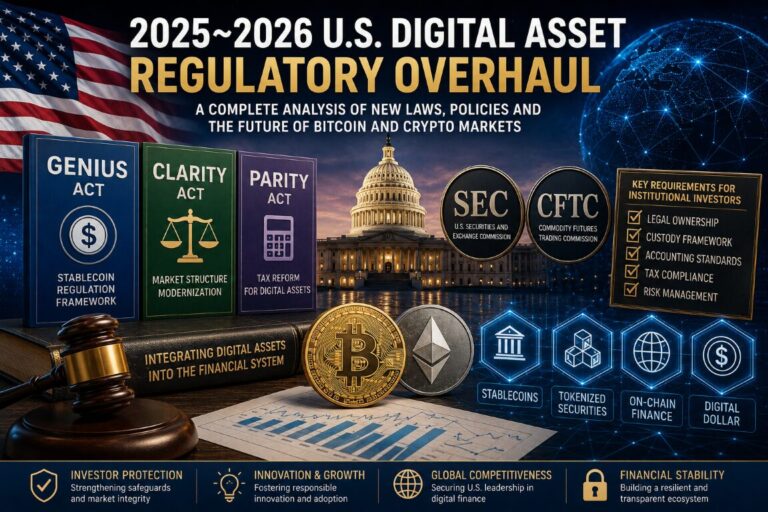
Analyzing Digital Dollar Hegemony & Financial Domination via the GENIUS, CLARITY, and PARITY Acts
The institutional integration of digital assets and the macroeconomic interlocking strategies of the US Treasury market.
Executive Summary
To state the conclusion first, the tri-fold US legislative initiatives—the GENIUS, CLARITY, and PARITY Acts—are not merely reactive frameworks for crypto regulation. Rather, they represent a highly synchronized macroeconomic financial strategy meticulously designed to perpetuate US Dollar Hegemony and federal state infrastructure dominance deep into the blockchain network era. By legally mandating private stablecoin issuers to back their tokens 100% with high-quality liquid assets—primarily short-term US Treasury bills (T-Bills)—the US expands federal debt demand. Concurrently, by harmonizing regulatory jurisdictions and modernizing fiscal codes, the framework aims to absorb global innovative capital directly into the domestic US capital ecosystem.
Table of Contents
- Chapter I. Introduction (Institutional Shift of Digital Assets & Research Objectives)
- Chapter II. The Evolution of US Digital Asset Regulation (From Early Enforcement to Spot ETF Approval)
- Chapter III. The Core Substance of US Legislative Reforms: Analysis of the Three Primary Acts
- Chapter IV. Global Regulatory Competition and Digital Financial Hegemony
- Chapter V. Dollar Hegemony, Stablecoins, and the Macroeconomic Anchoring of US Treasuries
- Chapter VI. Macroeconomic Scenario Projections and Structural Impacts (2026–2030)
- Chapter VII. Conclusion (Can the US Digital Asset Reforms Inaugurate a New Financial Order?)
Chapter I. Introduction
1. The Institutional Inflow of Digital Assets into Mainstream Finance
Published in the immediate aftermath of the 2008 global financial crisis, the Bitcoin whitepaper was far more than a simple technological proposal; it emerged as an alternative financial experiment reacting directly against the perceived systemic vulnerabilities and erosion of trust in centralized central banking and traditional financial intermediaries. While early digital assets remained confined to technical enthusiasts and ideologically driven cryptographic communities, the ecosystem has achieved exponential expansion over the past fifteen years.
By 2025–2026, the digital asset marketplace has matured into a multi-trillion-dollar independent asset class. The landmark approval of spot Bitcoin ETFs in the United States acted as an institutional catalyst, unleashing an unprecedented wave of capital from pension funds, endowments, asset managers, and insurance companies. Cryptocurrencies have firmly transcended the peripheral phase of being a mere “internet currency,” escalating into a pivotal agenda for national monetary regulation, financial statecraft, and macroeconomic policy.
This paradigm shift is not driven by simple asset price appreciation. The fundamental reality is that blockchain technology is transitioning out of speculative asset configurations and into highly sophisticated financial infrastructure. If the historical internet revolutionized the transmission of information, blockchain is actively redefining the trust architecture underlying the transmission of value. Consequently, contemporary debates must not be interpreted through the narrow lens of individual token price volatility, but rather as an institutional struggle to capture the architecture of the future global financial system.
2. Market Acceleration and the Manifestation of the Regulatory Gap
In stark contrast to the velocity of the digital asset industry’s expansion, the formulation of a comprehensive statutory framework has suffered prolonged delays. Even within the United States, which commands the world’s largest capital markets, an explicit legal codification of digital assets remained elusive for years. This stagnation stemmed from an enduring lack of consensus among regulatory bodies over whether these assets should be legally classified as commodities, securities, or entirely novel payment mechanisms.
As a direct consequence, the US regulatory apparatus historically favored a methodology of “Regulation by Enforcement” through retroactive litigation led by the Securities and Exchange Commission (SEC), rather than enacting forward-looking, explicit federal laws.
This approach institutionalized severe legal uncertainties for market participants. The inability to predict the legality of structural innovations stifled long-term capital formation and foundational value creation. Global entities such as Coinbase, Ripple, and Binance expended hundreds of millions of dollars in protracted legal disputes against federal agencies. In doing so, the United States paradoxically experienced an exodus of innovation, with home-grown tech firms seeking regulatory havens overseas.
3. The Post-FTX Regulatory Paradigm Shift
The catastrophic collapse of the global cryptocurrency exchange FTX in 2022 marked the most devastating crisis of trust in digital asset history and served as a crucial turning point for the regulatory regime. Despite commanding immense institutional capital and operating as the world’s second-largest exchange, FTX imploded rapidly due to non-existent internal controls, systemic leverage fraud, and the illicit misappropriation of customer deposits.
While this event triggered historic investor losses and damaged industry credibility, it provided the definitive political catalyst for bipartisan federal legislative reform. Prior to the FTX crisis, governance debates centered on *whether* to regulate the industry. Post-FTX, the mandate evolved into *how* to construct a robust, comprehensive regulatory framework. The overarching policy goal shifted definitively away from trying to isolate or ban the sector, moving toward stabilized integration inside the sovereign banking and financial system.
4. Research Objectives and Analytical Mandates
This study aims to dissect the core frameworks of the digital asset legislative overhaul spearheaded by the US Federal Congress and Executive branch during the 2025–2026 cycle, evaluating its subsequent economic and geopolitical implications. Specifically, this paper addresses three fundamental research mandates:
- First, what specific market failures and systemic friction points were the GENIUS, CLARITY, and PARITY Acts designed to mitigate?
- Second, how do these interlocking legislative frameworks structurally alter domestic US capital markets and the broader global digital asset value chain?
- Third, do these legislative actions reflect a short-term domestic industrial policy, or do they represent a macro-financial state strategy aimed at locking down Dollar Hegemony and modernizing state infrastructure for the blockchain era?
Chapter II. The Evolution of US Digital Asset Regulation
1. The Early Regulatory Regime: Criminal Enforcement and the Anarchic Era
During the initial years following the launch of the Bitcoin network in 2009, federal authorities largely dismissed digital assets as an insular, fringe technical experiment with zero systemic macroeconomic relevance. However, by 2013, explosive price appreciation and rising transaction volumes forced a drastic realignment of federal priorities.
The multi-agency shutdown of the ‘Silk Road’—an illicit darknet black market powered by Bitcoin—crystallized the sovereign state’s recognition of decentralized currencies. During this early phase, state action was strictly confined to Anti-Money Laundering (AML) enforcement and Counter-Terrorism Financing (CFT) under criminal statutes. However, capturing a naturally cross-border, borderless distributed network via lagging, purely retroactive criminal litigation proved structurally inefficient.
2. The ICO Boom and the Collision with Federal Securities Law
The year 2017 witnessed a qualitative metamorphosis within the cryptographic landscape. The activation of the Ethereum network and the popularization of Smart Contract protocols enabled global projects to pool capital directly from international investors by issuing proprietary tokens, bypassing traditional centralized investment banks entirely through Initial Coin Offerings (ICOs).
| Conceptual Definition & Characteristics | Comparison with Traditional Finance |
|---|---|
| ICO | An innovative mechanism where blockchain projects mint and distribute utility or governance tokens to raise capital directly from global investors. While structurally similar to an Initial Public Offering (IPO), ICOs historically bypassed formal registration statements, prospectus requirements, or federal regulatory vetting. |
While the ICO boom demonstrated unparalleled technological efficiency in global capital formation, it fundamentally threatened the integrity of public investor protection laws. As speculative manias birthed ghost projects, fraudulent whitepapers, and malicious developer exit scams (‘Rug Pulls’), the US SEC aggressively intervened using its existing statutory toolkits.
3. Legal Application and Structural Limitations of the Howey Test
To establish statutory authority over ICO tokens, the SEC relied entirely on the **Howey Test**, a legal doctrine articulated by the US Supreme Court in its landmark 1946 ruling (*SEC v. W.J. Howey Co.*). Consequently, an 80-year-old legal standard originally designed to evaluate citrus grove investment contracts became the definitive federal benchmark for evaluating cutting-edge crypto-assets.
■ The Four Prongs of the Howey Test
Under federal jurisprudence, an asset transaction is legally deemed an “investment contract” (and thus a security subject to SEC oversight) if it simultaneously satisfies four immutable criteria:
- An investment of money
- In a common enterprise
- With a reasonable expectation of profits
- Derived solely from the entrepreneurial or managerial efforts of others
The SEC asserted that the overwhelming majority of token purchasers were not acquiring tokens for immediate network utility, but rather as speculative instruments with an expectation of profit generated by the core developers’ marketing and technological upgrades.
Conversely, the crypto industry vehemently countered that tokens functioned as cryptographic gas fees (such as Ethereum’s Gas) or localized governance rights within decentralized networks, meaning they lacked the structural features of corporate stock or debt. This fundamental divergence deepened market gridlock.
4. Fragmented Judicial Precedents: The Ripple and Coinbase Litigations
Operating in a legislative vacuum, the SEC’s hyper-aggressive enforcement posture ultimately generated highly fragmented judicial interpretations within federal courts:
- SEC v. Ripple Labs: The federal district court delivered a split decision, ruling that the XRP token itself is not inherently a security, but that its classification depends entirely on the context of the sale (institutional sales via formal contracts constituted securities, whereas programmatic sales on secondary spot exchanges did not). This shifted the focus from the intrinsic nature of the asset to the environmental context of its distribution.
- SEC v. Coinbase: The commission sued the largest domestic exchange for operating an unregistered national securities exchange, broker, and clearing house. Coinbase hit back, arguing that enforcing compliance without providing an explicit path to registration violated the Administrative Procedure Act’s core mandates of fair notice and predictability.
This regulatory volatility triggered a systemic risk of capital flight, prompting prominent web3 firms to establish core tech architectures in friendlier legal environments such as Dubai, Singapore, and Switzerland.
5. The Spot Bitcoin ETF Approvals as an Institutional Milestone
The historic regulatory approval of spot Bitcoin ETFs in early 2024 served as the definitive institutional bridge connecting decentralized assets with traditional capital markets. Forced by federal appellate court mandates that overturned prior SEC rejections as “arbitrary and capricious,” this structural integration fundamentally transformed global wealth allocation. Traditional asset managers can now obtain direct exposure to digital asset movements within standard brokerage accounts, completely eliminating structural custody, security, and complex cryptographic accounting risks.
Chapter III. The Core Substance of US Legislative Reforms: Analysis of the Three Primary Acts
Section 1. The GENIUS Act: Stablecoin Structural Regulation and the Digital Dollar Paradigm
While retail speculation naturally concentrates on high-volatility native layer-1 tokens, the true operational architecture and structural liquidity engine of the decentralized web (DeFi) is anchored by stablecoins. Tether (USDT), USD Coin (USDC), and PayPal USD (PYUSD) function as the primary transactional medium for cross-border settlements and asset collateralization. Crucially, over 90% of global stablecoin liquidity is explicitly pegged to the US Dollar. The GENIUS Act codifies federal oversight over this network by enforcing three rigorous pillars:
■ Stablecoin (GENIUS Act Framework)
A digital asset engineered to maintain an immutable 1:1 parity with a sovereign fiat currency (predominantly the US Dollar). The GENIUS Act outlaws all algorithmic or uncollateralized structural configurations, requiring issuers to maintain transparent, high-quality liquid reserves.
① 100% High-Quality Liquid Asset (HQLA) Reserve Mandate: Issuers are legally compelled to back all outstanding tokens with cash deposits and short-term US Treasury bills with maturities under 90 days, neutralizing algorithmic de-pegging risks.
② Independent Monthly Attestations and Standard Audits: Mandates comprehensive public financial disclosures verified by certified independent accounting firms under FDIC and OCC supervision, drastically mitigating systemic bank-run vulnerabilities.
③ Strict Federal Licensing Requirements: Limits stablecoin issuance rights exclusively to fully capitalized, federally approved financial institutions, integrating them directly into the federal safety net.
The Macroeconomic Link to the US T-Bill Market
The profound geopolitical consequence of the GENIUS Act is the systematic generation of captive demand for US sovereign debt. As global adoption of dollar-pegged stablecoins expands, private issuers must purchase massive volumes of short-term T-Bills to maintain statutory reserve compliance. This allows the federal state to absorb deficit spending via private digital capital, offsetting declining treasury purchases by foreign central banks.
GENIUS Act Triggers Mandatory 100% Reserve Requirements
Massive Institutional Absorption of Short-Term US Treasuries (T-Bills)
Stabilization and Funding of Federal Deficit Spending via Private Digital Networks
Section 2. The CLARITY Act: Resolving Jurisdictional Warfare and Market Structure Overhaul
The CLARITY Act comprehensively resolves the historic regulatory gridlock between the SEC and the Commodity Futures Trading Commission (CFTC) by establishing explicit, quantitative metrics to define **”Decentralization Progression”**. If a digital asset project satisfies these strict structural criteria, it is legally classified as a **Digital Commodity**, automatically removing it from the SEC’s strict corporate disclosure rules and placing it under the commodity oversight of the CFTC.
| Decentralization Metrics | Statutory Thresholds & Legal Framework |
|---|---|
| Governance Dispersion | No single development entity, foundation, or insider group maintains unilateral veto power or centralized control over the code or network rule alterations. |
| Token Concentration Limits | Insiders, founders, and affiliated corporate entities collectively own less than a specified federal threshold (e.g., 20%) of the total circulating token supply. |
| Operational Autonomy | The underlying ledger and node network remain fully functional, secure, and operational even if the original software development enterprise dissolves or ceases commercial activity. |
Section 3. The PARITY Act: Fiscal Modernization and the Eradication of Tax Friction
Historically, the Internal Revenue Service (IRS) treated digital assets as “Property,” triggering capital gains tax tracking for even the smallest commercial interactions. This meant that purchasing a consumer product (e.g., a cup of coffee) with a stablecoin required tracking microscale price cost-basis variations—creating an administrative barrier to transactional utility. The PARITY Act systematically removes these systemic distortions:
① De Minimis Tax Exemption for Personal Transactions: Eliminates capital gains reporting requirements for all everyday consumer retail transactions under $200, legalizing stablecoins as a practical medium of exchange.
② Deferral of Staking and Validation Rewards: Corrects the punitive “Phantom Income” taxation rule. Staking rewards are no longer taxed immediately upon cryptographic receipt, but are deferred until the moment the validator formally liquidates or sells the assets for fiat currency on the market.
③ Enforcement of the Wash Sale Rule: To align digital assets with public stock markets, the act implements standard wash-sale rules, preventing traders from immediately harvesting tax losses while retaining structural exposure to the identical digital asset.
■ Phantom Income
A tax liability triggered on paper-basis asset accumulation before an actual market liquidation event occurs, leaving the taxpayer with severe cash-flow friction if the asset price plunges post-taxation.
Chapter IV. Global Regulatory Competition & Scenario Matrix
As the European Union moves forward with its comprehensive MiCA (Markets in Crypto-Assets) regulations and East Asian hubs implement rigid licensing matrices, the global landscape has transitioned into a highly competitive geo-economic race. The strategic question is no longer whether sovereign states will tolerate distributed technologies, but which jurisdiction will capture the primary inflows of international venture capital.
↔
↔
| Evaluation Metrics | Goldilocks Scenario (Institutional Inflow) | Contagion Scenario (Systemic Friction) |
|---|---|---|
| Sovereign Currency Dominance | Stablecoins capture over 85% of cross-border retail payment rails, expanding the digital domain of the US dollar. | Offshore networks and non-aligned digital payment rails gain traction, fragmenting Western financial control. |
| Treasury Market Stability | Private reserves act as an elastic, perpetual funding mechanism for short-term federal bonds. | Massive on-chain liquidations force sudden T-bill sell-offs, causing extreme friction in short-term repo markets. |
Chapter VII. Conclusion
Can the US Digital Asset Reforms Inaugurate a New Financial Order?
1. The Shifts Identified by This Study
This study has identified a critical macro-institutional pivot while analyzing the digital asset legislative reforms sweeping the United States through the 2025–2026 cycle. Although the GENIUS Act, CLARITY Act, and PARITY Act independently address stablecoins, market architecture, and fiscal tax codes respectively, they exhibit a deeply cohesive, unified vector. Rather than treating distributed ledger networks as an external anomaly or an unruly edge-case to be isolated, all three frameworks seek to systematically integrate digital assets directly into the core infrastructure of regulated sovereign finance. This represents a profound shift away from the erratic methodology of “Regulation by Enforcement” that characterized the preceding decade of American financial governance.
2. The True Scope of the American Structural Ambition
According to our structural analysis, recent updates in US federal policy transcend simple industrial incentives to either nurture or suppress the crypto-currency ecosystem. The simultaneous execution of stablecoin reserves codification, clear definitions of digital commodities, and transactional tax relief indicates that Washington has begun treating distributed networks as a native extension of state financial infrastructure. However, researchers must remain cautious before flatly branding this as an explicit, omnipotent “Dollar Hegemony Strategy.” More precisely, the United States is building the necessary institutional and legal safeguards to preserve, protect, and potentially amplify the baseline centrality of the dollar and domestic capital markets within an environment where decentralized architecture is growing organically.
3. Stablecoins: Systemic Threat or Hegemonic Extension?
It remains highly instructive to recall that when stablecoins first proliferated, legacy monetary authorities overwhelmingly perceived them as a direct existential threat to state sovereignty. Contemporary policy execution reveals a starkly different trajectory. If private, dollar-backed stablecoins solidify their position as the dominant transactional rail for cross-border settlement and decentralized liquidity pools, the practical geostrategic reach of the US Dollar could achieve an unprecedented technological upgrade. Indeed, internal whitepapers from the European Central Bank (ECB) have increasingly raised concerns that the unfettered expansion of private USD stablecoins will actively compound the structural dominance of the dollar over European retail markets. Nonetheless, this outcome is far from guaranteed. The ongoing evolution of sovereign CBDCs, Europe’s unified MiCA regime, China’s expansion of the digital yuan (e-CNY), and the growth of commercial bank tokenized deposits (Tokenized Deposits) represent formidable countervailing forces.
4. Institutionalization Does Not Guarantee Structural Success
Furthermore, this study underscores a fundamental axiom of financial statecraft: legislative clarity is a necessary condition for market maturity, but it is never a sufficient condition for economic success. While the GENIUS Act introduces rigorous capital backing mandates and strict auditing supervision, it cannot entirely eradicate the structural risks native to stablecoin instruments. Macro-financial research continues to warn that during periods of extreme systemic duress, catastrophic on-chain liquidations could trigger unprecedented feedback loops in traditional short-term repo and credit markets. Similarly, while the CLARITY Act effectively dismantles legal ambiguity, it possesses no intrinsic mechanism to dictate the actual direction of technological innovation or global capital competition. Legislation can establish the boundaries of the playing field, but it cannot guarantee the vitality of the players.
5. Historical Placement of the Current Paradigm
When viewed through the long arc of economic history, the technological trajectory currently unfolding mirrors the developmental lifecycles of past infrastructural revolutions. The rapid layout of global railroads triggered massive speculative panics; the early internet birthed the structural wreckage of the dot-com bust; and the introduction of ETFs initially faced fierce academic blowback for distorting public asset price discovery. Over time, however, each of these innovations normalized into the baseline infrastructure of the global economy. Digital assets are tracing an identical evolutionary line. What can be definitively asserted today is not the identity of the final market victors, but rather the fact that major sovereign powers have formally entered the arena of digital financial architecture design.
6. Structural Barriers to Entry: Native Technical Limitations
Crucially, the statutory engineering of the American federal state faces deep, fundamental ‘Technical Limitations’ built into the very fabric of distributed ledgers. These architectural vulnerabilities represent the most significant threat to the macro-stability envisioned by new federal codes:
• The Scalability Trilemma and Settlement Finality Conflict: While frameworks like the GENIUS Act attempt to institutionalize stablecoins as standard payment instruments, the baseline throughput constraints (TPS) of secure, decentralized consensus mechanisms remain structurally incapable of processing trillion-dollar real-time gross settlement (RTGS) volumes. Furthermore, the ‘probabilistic finality’ inherent in public blockchain ledgers directly contradicts the demand for immediate, absolute, and legally binding settlement finality required by sovereign central banks.
• Interoperability Exploits and Cross-Chain Vulnerabilities: In an ecosystem characterized by highly fragmented layer-1 networks and independent private ledgers, capital migration depends heavily on cross-chain bridges. These bridges represent massive technical honeypots and remain acutely vulnerable to smart contract exploits and logical hacks—presenting a continuous security risk that federal oversight cannot magically suppress.
• The Anonymity Gap and Regulatory Tech (RegTech) Lag: The strict Anti-Money Laundering (AML) standards demanded by the CLARITY Act run technologically parallel to the accelerating advancement of on-chain privacy technologies, such as Zero-Knowledge Proofs (ZKPs). The development of supervisory RegTech capable of tracking metadata without violating user privacy continues to lag significantly behind the rapid iteration of decentralized finance (DeFi) protocols.
7. Research Limitations and Future Horizons
While this study provides a vital, forward-looking evaluation of the structural dynamics underlying American macro-financial statecraft, it operates under explicit academic constraints:
• Severe Empirical Data Constraints: Because the GENIUS, CLARITY, and PARITY Acts are inside their formative phases of formal activation, long-term empirical data mapping their quantitative impacts on real capital velocity, Treasury yield spreads, and asset correlation matrix shifts remains structurally limited.
• Anglo-American Jurisdictional Bias: By hyper-focusing on the institutional mechanisms of the United States, this paper naturally glosses over the operational realities of competing framework alignments, such as the actual enforcement outcomes of Europe’s MiCA or the physical clearing infrastructure of the BRICS digital network.
• Static Technical Assumptions: The technical limitations outlined herein assume a relatively static pace of underlying cryptographic performance. Should layer-2 state channels or zero-knowledge scaling solutions achieve an unexpected order-of-magnitude breakthrough, the structural baseline of this paper’s architectural critiques must be recalibrated.
Consequently, future scholarly endeavors must prioritize quantitative on-chain empirical auditing once these laws are fully operationalized, alongside deep comparative law assessments regarding global regulatory harmonization.
Final Synthesis
The US digital asset legislative overhaul of 2025–2026 does not guarantee the commercial triumph of the crypto-asset marketplace, nor does it definitively secure the absolute immortality of Dollar Hegemony. Furthermore, it does not represent a blueprint drafted with perfect technical solutions already in place.
Instead, this era will be historically defined as the precise moment digital assets permanently escaped the loose regulatory periphery and migrated directly into the absolute center of sovereign monetary policy, systemic stability modeling, cross-border payment architecture, and global geopolitical competition. The ultimate structural equilibrium generated by the GENIUS, CLARITY, and PARITY Acts remains unwritten. What they definitively illustrate, however, is that the American state has ceased viewing blockchain as a mere target for isolation; it has committed to a historic, highly complex institutional and technical experiment to absorb distributed ledgers directly into the future architecture of global power.
Therefore, the systemic shift we are currently witnessing does not signify the static birth of a finalized financial order—it represents the critical, highly volatile transition point that will determine exactly how the future digital financial architecture of the world will evolve.